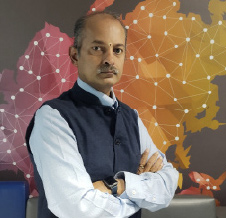


PUNEET CHADHA
Global Chief Marketing Officer, Redington
Evolving Marketing Strategy for the AI Era
The most important change is not simply the use of AI in marketing. It is the transformation of marketing’s role in an AI-driven enterprise.
Marketing can no longer operate as the communication layer that enters after the business strategy has been decided. It must help identify growth opportunities, shape the go-to-market model, mobilise the partner ecosystem and connect every marketing investment to a measurable customer or business outcome.
At Redington, our strategy is evolving from promoting products to orchestrating growth. Our enduring purpose is to reduce technology friction, while our Unlock Next-Orchestrating Growth Across the Technology Ecosystem positioning expresses how we bring that purpose to life. We connect technology brands, channel partners, ISVs, hyperscalers, customers, platforms, services and market intelligence so that innovation becomes accessible, understandable and deployable.
There are four important shifts within this strategy.
• Demand Generation at Scale - AI and analytics allow us to move from broad campaigns to intelligent, account- level engagement. We can combine market intelligence, behavioural signals, third-party intent data and historical performance to identify which accounts are showing an inclination to buy, what business problem they may be trying to solve, and which partner is best positioned to engage them. AI can help personalise communication, optimise media and accelerate lead qualification, while integrated lead assignment and sales feedback create a closed loop from engagement to opportunity and closure. The objective is not to produce more leads. It is to produce better opportunities, improve conversion velocity and enable our sales and partner teams to have more relevant conversations.
• Corporate storytelling to ecosystem storytelling - Through Unlock Next, the partner and customer become the heroes of the story. Technology matters, but what people remember is the hospital that improved patient care, the manufacturer that reduced downtime, the small business that reached a new market or the channel partner that built an entirely new services practice. Our role is to make these stories visible and repeatable across the ecosystem.
• Democratising marketing capability - Many capable channel partners have deep customer relationships but may not possess sophisticated marketing teams, automation platforms or content studios. Through Marketing-as-a- Service, structured partner-growth programmes, joint demand generation and smarter deployment of market- development funds, we can give them access to strategy, content, campaigns, analytics and lead generation as a shared capability. MDF must increasingly be treated as growth capital, not merely as reimbursement for completed activities.
• Connecting digital engagement with physical experience - AI cannot be understood only through presentations. It must be experienced. Our AI Exchange, Academy, digital platforms and planned AI experience centers and launchpads are intended to help partners move through a practical journey: discover a use case, see it working, build capability, engage a customer and scale the solution. For me, the most inspiring possibility is democratisation. A partner serving customers in a Tier-2 or Tier-3 city should not feel that the AI revolution is happening somewhere else. That partner should be equipped to become the most trusted AI adviser in the local market. The real test of technology leadership is not how many people are impressed by AI. It is how many people are empowered by it.

See What’s Next in Tech With the Fast Forward Newsletter





Tweets From @varindiamag
Nothing to see here - yet
When they Tweet, their Tweets will show up here.