
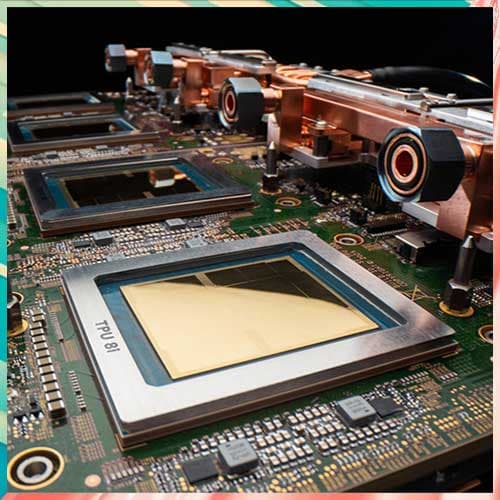
Google has recently unveiled its 8th-generation Tensor Processing Units (TPUs), marking a significant advancement in hardware designed specifically for artificial intelligence workloads. This new generation introduces two purpose-built architectures: the TPU 8t, optimized for training AI models, and the TPU 8i, engineered for efficient inference tasks. These custom-designed accelerators are poised to deliver substantial utility and advantages, particularly for the development and deployment of sophisticated AI agents, large language models, and advanced generative AI applications
The 8th-generation TPUs offer vastly increased memory and interchip bandwidth, crucial for handling the immense data and computational demands of modern AI. Unlike general-purpose processors, TPUs are uniquely optimized for the mathematical operations that underpin deep learning models, such as massive matrix multiplications and tensor operations, ensuring extreme efficiency in processing complex algorithms
For AI agents, the utility of these new TPUs is profound. AI agents often require rapid processing of diverse data types, real-time decision-making, and continuous learning. The 8th-gen TPUs provide the necessary computational horsepower to accelerate these functions, enabling agents to perform tasks like complex problem-solving, code generation, and interacting with dynamic environments more effectively. This specialized hardware infrastructure is foundational for building the next generation of intelligent and autonomous AI agents.
Google's TPUs are specifically engineered to tackle the AI bottleneck by efficiently training models through hardware tailored for large matrix operations. The 8th generation further refines this capability, ensuring that AI models can be trained and deployed with maximum acceleration. This high-performance acceleration is critical for iterating quickly on model designs, handling larger datasets, and achieving superior accuracy in AI agent development.
Beyond raw performance, Google's long-term investment in custom TPUs provides a significant cost advantage. Reports indicate that these units can enable AI computation at a fraction of the cost compared to other leading solutions. This cost-effectiveness is a game-changer for businesses and researchers, making advanced AI development more accessible and economically viable, thereby democratizing access to powerful AI infrastructure for a wider range of applications and agents.
The advancements in the 8th-gen TPUs are particularly impactful for generative AI and large language models, which are often the backbone of sophisticated AI agents. These models demand immense computational resources for both training and inference. The improved memory and bandwidth of the new TPUs facilitate the development of more complex and capable generative AI models, leading to more realistic content generation, more nuanced language understanding, and more intelligent agent behaviors.
Ultimately, Google's 8th-generation TPUs solidify its strategic advantage in the rapidly evolving AI landscape. By providing purpose-built, highly efficient, and cost-effective hardware, Google is empowering developers and organizations to push the boundaries of what AI agents can achieve. This continuous innovation in specialized AI hardware is crucial for scaling AI capabilities and ensuring that Google Cloud remains a leading platform for cutting-edge AI research and deployment.