
New opt-in feature links Gemini’s image generation with Google Photos, enabling more personalised outputs while raising questions around data usage, privacy, and the growing role of AI in everyday digital experiences.
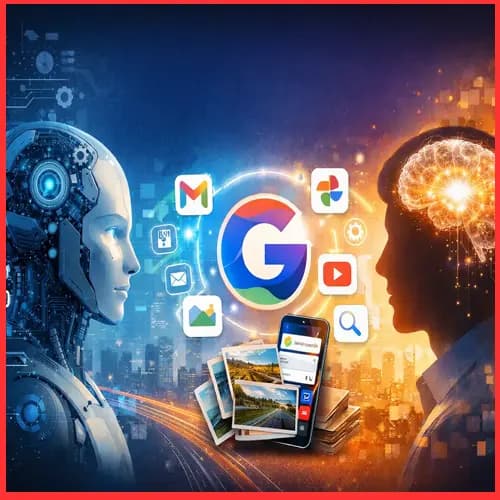
Google has extended its “personal intelligence” capabilities in Gemini by integrating its AI image generation tools with Google Photos, allowing users to create more personalised visual content using their own photo libraries.
The feature, introduced as part of Google’s broader push to customise AI experiences, enables users to opt in and grant Gemini access to their stored images and associated labels. This allows the system to generate images based on personal context, reducing the need for detailed prompts while improving output relevance.
The integration builds on existing functionality within Google’s image model, often referred to as Nano Banana 2, which already allowed users to upload reference images manually. By linking directly to Photos, the process becomes more seamless, enabling the AI to automatically identify relevant images and context.
Simplifying prompts with personal context
With the new capability, users can issue simpler prompts such as referencing “my family” or “my pet,” and Gemini will draw on tagged images within the Photos library to generate results. The system uses labels and visual cues to interpret context, helping produce more tailored and accurate outputs.
This approach reflects a broader trend in AI development, where incorporating personal data can significantly enhance performance. By reducing the effort required to provide context, Google aims to make AI tools more intuitive and accessible, potentially encouraging wider adoption among everyday users.
However, the company acknowledges that the feature is still evolving. There may be instances where the AI selects incorrect images or misinterprets context. To address this, users can review which images were used in the process or manually select specific photos to guide the output more precisely.
Privacy controls and gradual rollout
Google has emphasised that while the feature accesses personal photos for generating outputs, it does not use these images to train its underlying AI models. Instead, user inputs and generated outputs may be analysed to improve system performance, a distinction the company says is important for user privacy.
The feature is disabled by default and is currently available only to subscribers of Google’s paid AI plans. Users retain control over which services—such as Photos, Gmail, or YouTube—are connected to Gemini when enabling personal intelligence.
As with many AI features, the rollout is expected to expand over time. While the added personalisation could enhance usability, it may also raise concerns among users about how much data they are willing to share in exchange for convenience.
With this move, Google continues to position Gemini as a more context-aware AI platform, blending personal data with generative capabilities to deliver increasingly customised digital experiences.