
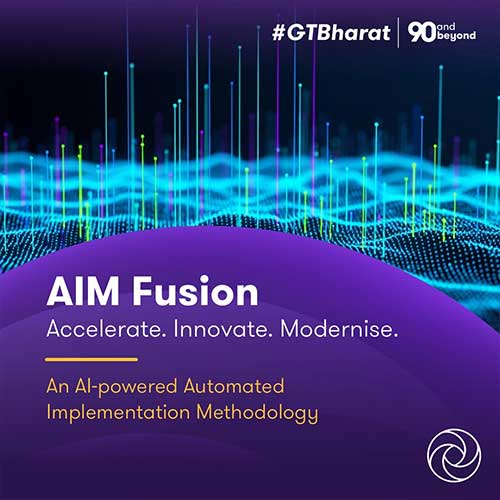
Grant Thornton Bharat has introduced AIM Fusion, an AI-powered methodology designed to accelerate and strengthen Oracle Fusion implementations as enterprises increasingly modernize their cloud ERP environments.
Part of the firm's broader Automated Implementation Methodology framework, AIM Fusion combines four specialized AI agents with human expertise. Grant Thornton Bharat says the approach can reduce the journey from requirements definition to deployment by more than 30%, while improving consistency, documentation and governance.
The four-agent architecture covers the implementation lifecycle. The Discovery Agent structures requirements and fit-gap assessments; the Design Agent generates solution designs and configuration recommendations; the Test & Train Agent develops testing and training materials; and the Validation Agent checks deployed configurations against approved requirements and designs.
Maneesh Sharma, Partner and Enterprise Applications Leader, Grant Thornton Bharat, said: "With AIM Fusion, we are reshaping the future of Oracle Fusion implementations by combining AI-powered agents with human expertise to deliver faster, smarter and more consistent transformation outcomes. Every workshop, client interaction and deliverable can generate sharper insights, helping clients make better decisions, move faster and realise value sooner.
Discovery cycles that traditionally take weeks can now be compressed into days, with solution options available from Day One. Clients benefit from end-to-end traceability across requirements, configuration, testing and training, supported by more comprehensive solution designs and rigorous validation. Our vision is to make GTBharat’s collective Oracle Fusion implementation knowledge more accessible, reusable and consistently applied across every transformation journey."
AIM Fusion reflects a broader shift in enterprise AI. AI agents are moving beyond copilots and content generation into complex implementation workflows, where they can assist with discovery, design, testing, validation and knowledge management.
However, the Human + AI model remains important. ERP implementations involve business-critical processes, financial controls and organizational decisions where AI-generated recommendations still require expert review and accountability.
AI is beginning to transform not only enterprise software, but also how enterprise software itself is implemented.

See What’s Next in Tech With the Fast Forward Newsletter







Tweets From @varindiamag
Nothing to see here - yet
When they Tweet, their Tweets will show up here.