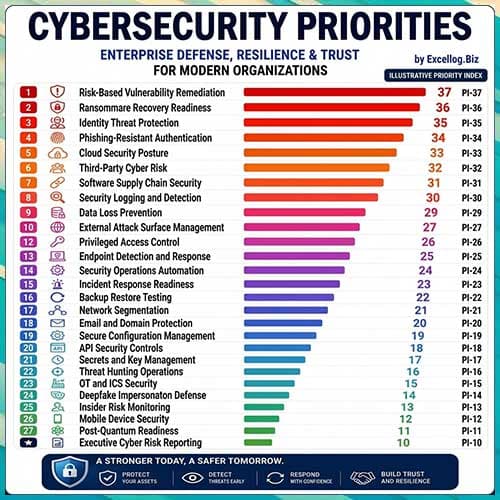
Looking at the chart, Identity Threat Protection ranks third overall (PI-35) - just behind Risk-Based Vulnerability Remediation and Ransomware Recovery Readiness - and that positioning isn't accidental. Here's the connection you're drawing out, laid out clearly:
Identity Is the New Perimeter
In a cloud-first, hybrid-work world, there's no longer a hard network boundary to defend. The attacker's actual target has shifted from breaking into infrastructure to impersonating a legitimate identity - as we discussed with the Bank of Baroda case, a single compromised employee credential was enough to expose hundreds of gigabytes of sensitive data, with core systems never technically "breached" at all. This is precisely why the chart pairs Identity Threat Protection (PI-35) directly with Phishing-Resistant Authentication (PI-34) and Privileged Access Control (PI-26) - they're all facets of the same underlying problem: can the system trust that the entity acting is who it claims to be?
Trust Is Earned Through Verifiable Identity + Enforced Privacy
Your framing is right: trust isn't an abstract feeling a company asks customers to have - it's a measurable output of two things working together:
1. Identity assurance - knowing with confidence that access requests come from legitimate, authenticated identities (not stolen credentials, not deepfaked personas - note Deepfake Impersonation Defense at PI-14 climbing the priority list too).
2. Privacy enforcement - ensuring that once identity is verified, the data that identity can see or move is governed by clear consent, purpose limitation, and access boundaries (this is exactly what the DPDP/GDPR-style consent and data-discovery products we discussed earlier are built to enforce).
Put together: Identity Threat Protection answers "who is this really?" while Data Privacy answers "what are they allowed to touch, and did the data subject agree to it?" Neither is sufficient alone — a hacker with a legitimate-looking login but no privacy guardrails can still exfiltrate everything; a strong privacy policy means nothing if identity verification is broken and anyone can pose as an authorized user.
Why Data Security + Privacy Companies Are Positioned to Lead
This is where your point about visibility and observability becomes the real strategic opening. Looking at the chart's composition, a huge share of these priorities — Data Loss Prevention (PI-28), External Attack Surface Management (PI-27), Security Logging and Detection (PI-30), Third-Party Cyber Risk (PI-32) — are fundamentally visibility problems, not just control problems. You can't protect what you can't see, and most enterprises today have:
● Fragmented identity systems across cloud, on-prem, and SaaS
● Data scattered across 40–50+ sources (echoing the CDD/data-discovery capability we discussed) with no unified map of where sensitive data actually lives
● Third-party/vendor access nobody has fully audited (directly relevant to the Kudankulam-style third-party breach we covered)
Companies that can unify identity signals with data-flow visibility — showing not just "who logged in" but "what did that identity touch, where did the data go, and was that consistent with policy" — are solving the actual root problem underneath most of these 28 priorities simultaneously, rather than one narrow slice of it.
The Bigger Strategic Bet
This is likely why data security/privacy vendors are increasingly marketed not as "compliance checkbox" tools but as trust infrastructure - the same positioning we saw in the NPAV compliance discussion and the "data visibility and observability" framing you're using here. The pitch to enterprises is shifting from "we help you avoid fines" to "we give you the observability layer that makes Zero Trust actually enforceable," since Zero Trust as a philosophy is meaningless without continuous, verified visibility into both identity behavior and data movement.
In short: Identity Threat Protection defines who can be trusted; Data Privacy defines what that trust is allowed to access; and visibility/observability is the connective tissue that lets an organization actually prove - to regulators, customers, and its own board — that both are being upheld in real time, not just on paper.