
Breaking News
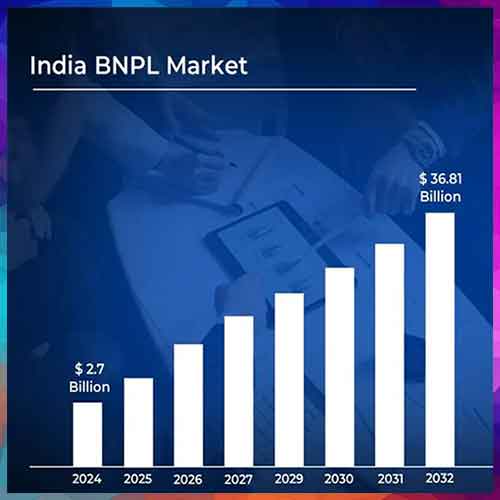
India’s buy now, pay later (BNPL) market is expected to grow 22.5% year-on-year to $30.45 billion in 2026, as pay-later offerings become increasingly embedded within UPI, cards and large digital payment ecosystems, according to industry estimates.
The sector saw rapid expansion between 2022 and 2025, recording a compound annual growth rate (CAGR) of 34.2%. Growth is forecast to moderate but remain strong, with the market expected to expand at a CAGR of 15.5% between 2026 and 2031, reaching about $62.61 billion by the end of the period.
The structure of India’s BNPL market has shifted sharply under tighter regulation by the Reserve Bank of India. Updated digital lending rules and restrictions on wallet-linked credit lines have reduced the viability of standalone BNPL fintech models, pushing the market toward bank-linked pay-later products, card-based EMIs and UPI-linked credit lines.
Competition is increasingly consolidating around a smaller set of regulated banks and non-banking financial companies (NBFCs) that power pay-later options across ecommerce platforms, wallets and UPI apps. Providers now compete more on underwriting quality, approval rates and merchant integration than on promotional pricing.
Ecommerce-led offerings from platforms such as Amazon Pay, Paytm and Flipkart remain influential, largely through partnerships with regulated lenders. Banks including ICICI Bank, HDFC Bank, Axis Bank and SBI dominate card-EMI and UPI-linked credit propositions, while fintechs such as LazyPay, Simpl and Kissht continue to operate at reduced scale or with revised models.
A key trend reshaping the sector is the delivery of BNPL through existing payment rails. RuPay credit cards can now be linked to UPI, enabling QR-based payments directly from credit lines, while the National Payments Corporation of India’s credit line on UPI framework allows banks to offer revolving or fixed credit via UPI handles.
With UPI processing more than 16.5 billion transactions in a single month in late 2024, industry executives say it has become the natural front end for consumer credit. Regulators and banks also prefer credit to flow through cards and formal credit lines that are fully reportable to credit bureaus and subject to prudential norms.
Small-ticket digital credit, including BNPL, has expanded rapidly, especially among younger and new-to-credit consumers. Industry data show digital lenders disbursed about ₹97,000 crore in the first half of FY2025, with roughly 80% of loans below ₹25,000. However, tighter bureau reporting and rising delinquencies are prompting banks to adopt more conservative underwriting, increasingly factoring BNPL exposure into broader credit assessments.
Market participants expect BNPL to remain a relevant entry-level credit option, but with stricter eligibility checks and lower limits. Analysts say the future of the sector lies in embedded, bank-backed models delivered through UPI and card infrastructure, rather than standalone pay-later apps.
The sector saw rapid expansion between 2022 and 2025, recording a compound annual growth rate (CAGR) of 34.2%. Growth is forecast to moderate but remain strong, with the market expected to expand at a CAGR of 15.5% between 2026 and 2031, reaching about $62.61 billion by the end of the period.
The structure of India’s BNPL market has shifted sharply under tighter regulation by the Reserve Bank of India. Updated digital lending rules and restrictions on wallet-linked credit lines have reduced the viability of standalone BNPL fintech models, pushing the market toward bank-linked pay-later products, card-based EMIs and UPI-linked credit lines.
Competition is increasingly consolidating around a smaller set of regulated banks and non-banking financial companies (NBFCs) that power pay-later options across ecommerce platforms, wallets and UPI apps. Providers now compete more on underwriting quality, approval rates and merchant integration than on promotional pricing.
Ecommerce-led offerings from platforms such as Amazon Pay, Paytm and Flipkart remain influential, largely through partnerships with regulated lenders. Banks including ICICI Bank, HDFC Bank, Axis Bank and SBI dominate card-EMI and UPI-linked credit propositions, while fintechs such as LazyPay, Simpl and Kissht continue to operate at reduced scale or with revised models.
A key trend reshaping the sector is the delivery of BNPL through existing payment rails. RuPay credit cards can now be linked to UPI, enabling QR-based payments directly from credit lines, while the National Payments Corporation of India’s credit line on UPI framework allows banks to offer revolving or fixed credit via UPI handles.
With UPI processing more than 16.5 billion transactions in a single month in late 2024, industry executives say it has become the natural front end for consumer credit. Regulators and banks also prefer credit to flow through cards and formal credit lines that are fully reportable to credit bureaus and subject to prudential norms.
Small-ticket digital credit, including BNPL, has expanded rapidly, especially among younger and new-to-credit consumers. Industry data show digital lenders disbursed about ₹97,000 crore in the first half of FY2025, with roughly 80% of loans below ₹25,000. However, tighter bureau reporting and rising delinquencies are prompting banks to adopt more conservative underwriting, increasingly factoring BNPL exposure into broader credit assessments.
Market participants expect BNPL to remain a relevant entry-level credit option, but with stricter eligibility checks and lower limits. Analysts say the future of the sector lies in embedded, bank-backed models delivered through UPI and card infrastructure, rather than standalone pay-later apps.

See What’s Next in Tech With the Fast Forward Newsletter








Tweets From @varindiamag
Nothing to see here - yet
When they Tweet, their Tweets will show up here.