

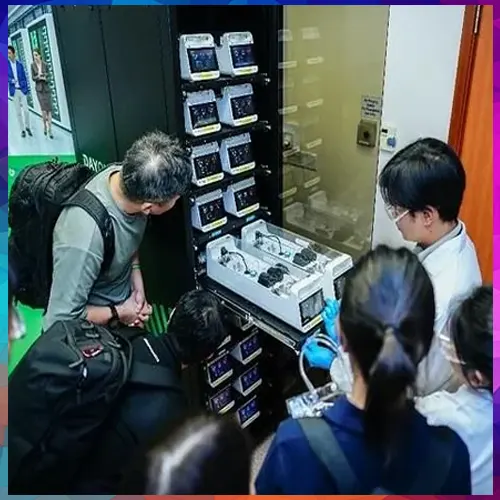
Singapore has demonstrated a biological computing prototype that combines living human neurons with silicon hardware inside a server-rack environment, exploring a new model for adaptive computing and AI beyond conventional semiconductor-based systems.
Singapore has unveiled what researchers describe as the world’s first independently operated biological data-centre prototype, bringing networks of living human neurons into an infrastructure designed around conventional server environments. The project combines biological computing with silicon-based technology and is being explored as a potential new direction for AI and high-efficiency computing.
The prototype was developed through a collaboration involving the Yong Loo Lin School of Medicine at the National University of Singapore (NUS Medicine), data-centre operator DayOne and biological computing company Cortical Labs. The system comprises 20 CL1 biological computing units, with each unit containing a network of laboratory-grown human neurons integrated with silicon hardware.
Based on the reported figure of about 800,000 neurons per CL1, the 20-unit installation represents an estimated 16 million living neurons operating within the prototype environment. The system was demonstrated at NUS on August 6, bringing biological computing technology closer to an infrastructure setting rather than restricting it to conventional laboratory experimentation.
Living neurons move into server infrastructure
The Biological Data Centre has been established at the NUS Life Sciences Institute to investigate how biological computing can be incorporated into practical computing environments. The participating organisations are contributing different capabilities to the project.
NUS Medicine is providing expertise in neurobiology and will manage the cultivation and maintenance of the living cells. DayOne is contributing knowledge of data-centre infrastructure, while Melbourne-based Cortical Labs is supplying the CL1 biological computing platform and associated technology.
During the August 6 demonstration, more than 80 representatives from academia, technology, digital infrastructure and industry observed the system in operation. Demonstrations included microelectrode-array integration and real-time neural network activity, offering a look at how living neural networks could function within an infrastructure resembling a server environment.
The initiative represents a departure from computing systems that depend almost entirely on conventional silicon processors. Instead, the prototype combines biological networks with electronic components, with the neurons serving as an active element of the processing system.
How the biological computing system works
Cortical Labs develops neural networks from human stem cells and grows them on silicon platforms equipped with microelectrode arrays. These electrodes provide a means of stimulating the neurons with electrical signals and capturing the electrical activity generated by the biological network.
The CL1 operates with Cortical Labs’ biological intelligence operating system, known as biOS, which enables software to communicate with the neural network. Researchers can send information to the neurons through electrical stimulation and interpret their resulting activity as part of a computing task or simulated environment.
An application programming interface allows researchers to stimulate the neural networks, monitor their activity and establish real-time feedback loops between biological and digital systems. As a result, the neurons are not simply being maintained alongside conventional servers; their activity forms part of the information-processing cycle.
Maintaining such a system also requires biological support. Cortical Labs says the CL1 incorporates an internal life-support mechanism capable of keeping neural cultures viable for up to six months.
The Singapore project therefore combines two traditionally separate disciplines—life sciences and digital infrastructure—to investigate whether living neural networks can contribute to future computing architectures. While the technology remains at the prototype stage, the deployment offers researchers a practical environment for studying biological intelligence alongside conventional computing systems.

See What’s Next in Tech With the Fast Forward Newsletter









Tweets From @varindiamag
Nothing to see here - yet
When they Tweet, their Tweets will show up here.