

The next major geopolitical confrontation may not begin on land or at sea, but hundreds of kilometres above Earth. Space is rapidly emerging as a strategic battleground where the United States, China and Russia are competing for technological dominance, military superiority and control over critical satellite infrastructure.
At the centre of this transformation is Elon Musk's SpaceX, whose Starlink satellite network has demonstrated the growing importance of commercial space infrastructure in modern warfare. The Russia–Ukraine conflict revealed how satellite connectivity can support battlefield communications, drone operations, intelligence sharing and military coordination.
However, Starlink's strategic importance has also raised concerns about the concentration of power in private technology companies. When national security operations depend on commercial satellite networks, decisions involving access, service restrictions and operational control can carry significant geopolitical consequences.
Recent disputes surrounding SpaceX's military-focused Starshield services in Ukraine have further highlighted the complexities of public-private defence infrastructure. They also expose the risks of relying heavily on a single technology provider for mission-critical communications.
Meanwhile, China, Russia and the United States are advancing counterspace technologies designed to disrupt, disable or destroy adversaries' satellite capabilities. These include anti-satellite missiles, electronic jamming, directed-energy systems, cyberattacks and spacecraft capable of approaching other satellites.
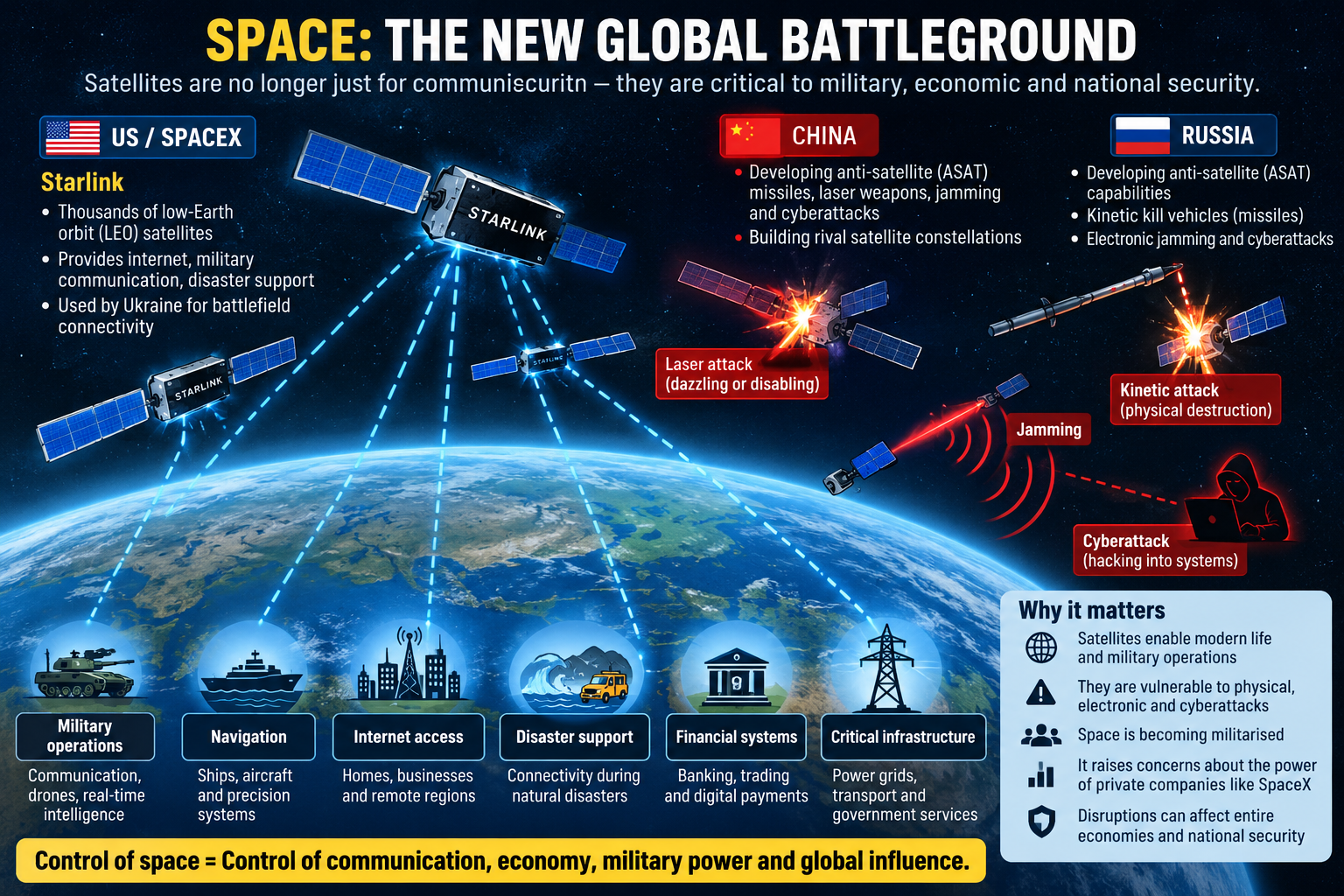
China's expanding space capabilities are particularly significant. Its investments in satellite constellations, orbital technologies and military space infrastructure reflect the growing importance of space in national security strategy. Washington and Moscow are also strengthening their counterspace capabilities, intensifying concerns about strategic competition.
Cyber warfare is becoming inseparable from space warfare. Attackers may not need to physically destroy satellites when interference with ground stations, communications links, software systems or navigation signals can disrupt critical services. Such attacks could affect military operations, aviation, financial transactions, emergency communications and civilian infrastructure.
The danger extends beyond individual countries. Destructive anti-satellite attacks can generate orbital debris, threatening spacecraft belonging to multiple nations and potentially disrupting services for years.
For India, this evolving environment underscores the strategic importance of strengthening indigenous satellite communications, space situational awareness, cybersecurity, secure navigation systems and resilient defence infrastructure. Protecting national space assets will increasingly become essential to digital sovereignty.
The larger question is no longer who controls the internet, but who controls the infrastructure connecting Earth from space. As satellite networks become central to economic and military power, governments must establish stronger international safeguards, transparent operating rules and effective cyber defences.
The emerging space race is therefore not simply about rockets, satellites or technological prestige. It is about controlling the digital infrastructure upon which future economies, national security systems and global communications will depend.
The next frontier of cybersecurity is orbital security—and the consequences of failure will be felt on Earth.