Elon Musk says progress on Tesla’s in-house AI5 chip has freed up resources to restart Dojo 3, as the company doubles down on custom silicon to power autonomous driving, robotics and future large-scale AI computing.
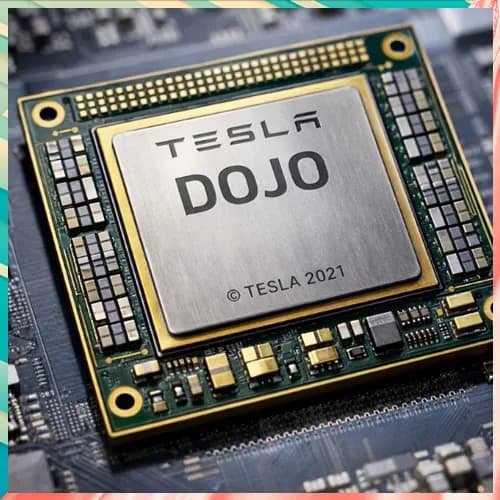
Tesla has restarted work on its Dojo 3 supercomputer after achieving what Elon Musk described as a major milestone in the development of the company’s latest in-house artificial intelligence chip. In a post on X, Musk confirmed that the AI5 chip design is now in “good shape,” allowing Tesla to redirect engineering and capital resources back to the long-paused Dojo programme.
The billionaire entrepreneur also indicated that Tesla is expanding its chip engineering teams, signalling a renewed push to build proprietary hardware that can rival leading AI processors from established players such as Nvidia. The move marks a reversal from late 2025, when Tesla had shelved parts of the Dojo roadmap, including its wafer-level processor initiative.
Shift to fully in-house supercomputing
Dojo 3 represents Tesla’s most ambitious attempt yet to create a fully self-reliant AI supercomputer built entirely on internal hardware. Earlier versions of Dojo relied partly on third-party accelerators. Dojo 2, which combined Tesla-designed chips with Nvidia GPUs, was eventually discontinued before completion.
According to Musk, Dojo 3 will be the first Tesla supercomputer powered exclusively by the company’s own AI silicon, starting with AI5 and later generations such as AI6 and AI7. These chips form part of a new development cadence under which Tesla plans to roll out a new AI chip roughly every nine months.
Musk has claimed that the AI5 chip delivers performance comparable to Nvidia’s Hopper-class processors on a single chip, while pairing two AI5 chips could achieve Blackwell-class performance at significantly lower power consumption. AI6 is expected to enter production next, with AI7 likely to build incrementally on that architecture.
High stakes after earlier setbacks
The revival of Dojo 3 comes against the backdrop of mixed results from Tesla’s earlier supercomputing efforts. Dojo 1, once touted as a potential industry leader, failed to outpace rapidly advancing Nvidia systems. Dojo 2 was abandoned midway, raising questions about Tesla’s ability to compete consistently in high-performance AI compute.
However, the company believes tighter integration between its chips, software and training workloads—particularly for autonomous driving and robotics—could give Dojo 3 a clearer purpose and competitive edge. Musk has also hinted that the system may support “space-based AI compute,” suggesting potential future applications beyond terrestrial data centres.
If successful, Dojo 3 could become a critical pillar of Tesla’s long-term AI strategy, reducing dependence on external suppliers while accelerating development of self-driving and other AI-driven technologies.