
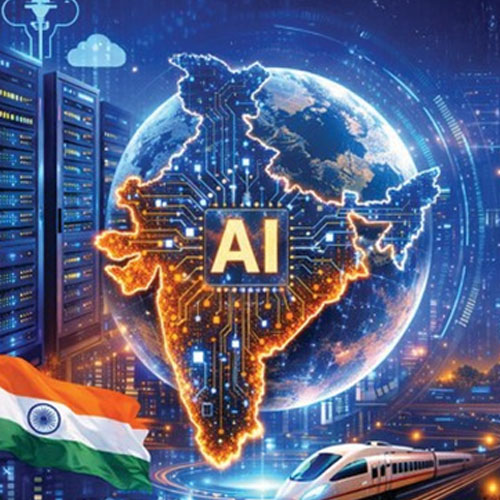
India is witnessing an unprecedented data centre revolution, powered by artificial intelligence, cloud computing, digital payments, 5G, data localisation and the growing need for sovereign digital infrastructure. With the market expanding at an estimated two to three times the global average, data centres are becoming critical infrastructure for India's digital economy. According to Anarock Capital, the country's data centre footprint could surge from about 27 million square feet today to more than 100 million square feet by 2030, potentially attracting nearly $300 billion in investment.
AI is fundamentally changing the scale and architecture of this infrastructure. Training and running advanced AI models requires thousands of GPUs, high-density computing clusters, sophisticated cooling systems and enormous amounts of electricity. India already has approximately 1.7 GW of operational IT capacity, with substantial additional capacity under construction or planned. Consequently, the data centre industry is evolving from conventional server hosting toward AI factories capable of supporting large-scale training, inference and agentic AI workloads.
Indian data centre operators are responding aggressively. Sify Technologies operates facilities across Mumbai, Chennai, Noida, Hyderabad, Bengaluru and Kolkata and is developing additional AI-ready capacity, including projects in Navi Mumbai and Chennai. CtrlS Datacenters is expanding across Hyderabad, Mumbai, Chennai, Bengaluru, Noida, Kolkata, Ahmedabad and Patna while targeting more than 4 GW of AI-ready infrastructure. NTT DATA, which incorporates the former Netmagic business, continues to strengthen its presence across major markets, including significant facilities in Noida and Kolkata.
The next phase is being shaped by AI-focused and sovereign-cloud infrastructure. Yotta Data Services operates hyperscale facilities in Navi Mumbai and Greater Noida, alongside GIFT City, and plans edge locations including Jaipur, Nagpur, Indore, Kochi, Coimbatore, Bhubaneswar, Patna and Guwahati. Its deployment of more than 20,000 NVIDIA Blackwell Ultra GPUs in Greater Noida illustrates how quickly demand is shifting toward accelerated computing. ESDS, meanwhile, continues expanding its sovereign cloud and data centre capabilities while identifying multiple Tier-2 cities as future growth markets.
Global hyperscalers are simultaneously making India a strategic pillar of their AI infrastructure plans. Google's planned $15 billion AI hub in Visakhapatnam could transform the city into a major computing and international connectivity gateway, supported by large-scale infrastructure and subsea cables. Microsoft has committed $17.5 billion toward cloud and AI infrastructure, skilling and operations in India, while expanding its cloud-region footprint. AWS is also increasing investments across its Mumbai and Hyderabad regions as enterprise demand for cloud and AI capacity accelerates.
Importantly, India's data centre map is beginning to move beyond Mumbai, Chennai, Bengaluru, Hyderabad and Delhi-NCR. Visakhapatnam is emerging as a major new investment hotspot, while cities such as Bhubaneswar, Ahmedabad, Jaipur, Patna, Kochi and Guwahati offer opportunities for edge and regional facilities. Bhubaneswar is particularly promising, with CtrlS and Yotta identifying the city in their expansion strategies. Lower land costs, improving fibre connectivity, state incentives and proximity to growing digital populations could make Tier-2 cities increasingly important to India's distributed computing infrastructure.
The opportunity nevertheless brings major challenges around power, cooling, water, cybersecurity and sustainability. AI data centres consume substantially more energy than traditional facilities, making renewable power, advanced storage and next-generation semiconductor technologies increasingly important. Infineon's move to acquire Bengaluru-based C2i Semiconductors reinforces India's growing role in developing power technologies for AI infrastructure. India's data centre boom is therefore no longer simply a real-estate or cloud story—it represents the convergence of AI, semiconductors, energy, connectivity and cybersecurity, creating the digital backbone required for India to emerge as a global AI powerhouse.
--------------------------------------------------------------------------------------------------------------------------------------
Nxtra sees itself as India’s digital infrastructure partner for the AI journey
ASHISH ARORA
CEO, NXTRA BY AIRTEL
Nxtra’s role is going to be much more than just building data centers. We see ourselves as the digital infrastructure partner for India’s AI journey, combining AI-ready, sustainable data center capacity with Airtel’s pan-India networks, global subsea systems, and cloud and cybersecurity capabilities. We are investing to move from roughly 300 MW today to 1 GW over the next few years, as India positions itself as a global hub for data centers and AI infrastructure, helping customers build and run AI workloads reliably, securely and at scale.
Sustainability is a core pillar of our growth strategy. As we scale towards 1 GW, we are guided by our commitment of Net Zero by 2031, 100% renewable energy through RE100, and SBTi-aligned climate targets. Our facilities are intelligently designed with modular architecture, liquid-ready cooling for high-density GPU workloads, and resilient low-carbon power systems. They incorporate cold aisle containment, free cooling, and AI/ML-driven thermal optimisation, with AI-driven energy optimisation enabling predictive operations and dynamic cooling to reduce energy consumption and lower PUE.
Demand for AI-ready data centers in India is exploding, with industry estimates suggesting overall data center capacity will grow by 30-40 per cent annually over the next few years, with AI and high-density workloads taking a larger share. Customers want scalable, GPU-ready capacity with the right power, cooling and connectivity guarantees. At Nxtra, we are staying ahead by building high-density, AI-ready campuses with clear headroom to keep adding capacity as India’s AI needs scale up.
------------------------------------------------------------------------------------------------------------------------------------
Architecting the network foundation for India's next-generation AI infrastructure
BATTULA
WHOLE TIME DIRECTOR & INTERIM CEO, INVENIA-STL NETWORKS
“India's data centre sector is moving beyond a capacity-led growth story. AI, cloud and hyperscale computing are changing infrastructure requirements, driving higher compute densities, power intensity, connectivity, advanced cooling and higher expectations around resilience and uptime. For Invenia-STL Networks, this plays to our strengths—our heritage in connectivity means we architect the network as part of the foundation, not a downstream layer. Combined with capabilities across data centre infrastructure, systems integration and managed services, we address the infrastructure lifecycle holistically. Power availability, grid connectivity, speed of deployment and specialised talent will determine how quickly capacity comes online.
The next phase of growth has to balance scale with sustainability, resilience and trust. Our focus is on designing energy-efficient infrastructure from the outset, through optimised PUE, advanced cooling and renewable integration. Resilience and security must be built in by design, through robust network architectures, redundancy, disaster recovery and managed services, while embedding cybersecurity across interconnected environments. Data sovereignty matters, for government, defence and regulated industries, with capabilities giving organisations control over their data.
India's installed capacity is projected to grow from around 1.8 GW in 2026 to over 8-12 GW by 2030, driven by AI adoption, cloud migration and digitisation. The challenge will be keeping pace - addressing power availability, grid readiness, land approvals and skilled talent. We are strengthening capabilities across the digital infrastructure stack, designing for higher compute densities, advanced cooling and renewable integration.”
-------------------------------------------------------------------------------------------------------------------------------------------
Workload readiness, not just capacity, will define the future of India’s data centers
KALYAN MUPPANENI
FOUNDER, CHAIRMAN & CEO, PI DATA CENTERS
“AI, cloud, and hyperscale computing are reshaping the engineering requirements of digital infrastructure, from power density and cooling to network bandwidth, storage I/O, and automation. At Pi, our strategy focuses on building infrastructure that supports today's mission-critical workloads while staying ready for the higher-density computing environments emerging with AI. Our cumulative footprint stands at 590,000 sq. ft. and 70 MW of live capacity, scalable to 140 MW.
AI is changing the data center equation. GPU-intensive workloads demand a fundamentally different approach to power distribution, thermal management, networking, and capacity planning. We see AI infrastructure as an integrated stack spanning data center, compute, GPU, network, storage, cloud, and managed operations, not just GPU deployment. Our green energy roadmap shifts consumption toward renewables through conservation-led design and modular expansion. Resilience comes from 2N architecture, independent power routes, and N+1 backup, while our SCADA/DCIM layer monitors both efficiency and faults. Cybersecurity and data sovereignty are equally strategic. Pi is MeitY-empaneled across public cloud, government VPC, and government community cloud, with ISO 27001, 27017, 27018, 22301, SOC 2 Type II, and PCI-DSS certifications. The greatest opportunity is the convergence of AI, cloud, sovereign infrastructure, and India's digital economy. Challenges include power availability, grid connectivity, cooling, capital efficiency, cybersecurity, talent, and evolving compute architectures. Our focus remains building scalable, automated, resilient, AI-ready infrastructure, anchored in efficiency, security, sovereignty, and cost discipline.”
-----------------------------------------------------------------------------------------------------------------------------------------
HPE's engineering depth in India is key to building AI-ready data centers
KAMAL KASHYAP
SENIOR DIRECTOR, COMPUTE & HVS, HPE INDIA
“India is at a pivotal stage in its digital infrastructure journey. The rapid expansion of AI, hybrid cloud adoption, Global Capability Centers (GCCs), digital services, and sovereign workloads is driving unprecedented demand for scalable, resilient, and AI-ready data center infrastructure. At HPE, we believe India is entering a new era of AI-led growth, and we are evolving our strategy accordingly. Our focus is on building AI-native, hybrid-by-design environments supporting enterprise applications, hybrid cloud workloads, AI training, and inferencing. Through GreenLake, we deliver a cloud operating experience across private, colocation, edge, and sovereign environments.
A key differentiator for HPE is our deep engineering presence in India, one of our largest global innovation hubs, combined with our Compute portfolio spanning ProLiant servers, AI-optimized systems, HPC infrastructure, storage, and hybrid cloud solutions. Solutions such as HPE Private Cloud AI and HPE AI Factory enable organizations to accelerate AI adoption while maintaining control, security, and governance. HPE also invests in energy-efficient infrastructure, advanced cooling, and secure-by-design architectures, with GreenLake and the HPE Sustainability Insight Center giving visibility into energy usage and carbon footprint.
Looking ahead, we see opportunities in Enterprise AI and inferencing, sovereign cloud, and growth of hyperscale, neo-cloud, and GCC ecosystems. The industry must address challenges around power, energy efficiency, cybersecurity, talent, and data sovereignty. Through our technology portfolio and A&PS expertise, HPE is helping customers build AI-ready, resilient, future-proof data centers.”
--------------------------------------------------------------------------------------------------------------------------------------
India poised to strengthen its position as a leading digital infrastructure market
M G REJITH
HEAD - HIT & DWP SERVICE LINE, GLOBAL DELIVERY UNIT, FUJITSU
“India's digital economy is at an important point in its growth, with data centres increasingly becoming the foundation that supports this progress. The rise of cloud adoption, AI, digital payments, e-commerce and data-driven services is creating steady demand for infrastructure that is reliable, scalable and secure. AI and data-intensive workloads require significantly higher compute, storage and network capacity than traditional applications, making advanced infrastructure critical to business operations. Customers also expect high availability, strong security and energy efficiency for long-term goals.
India's policy environment is helping accelerate this growth, strengthening the country's cloud, AI and digital ecosystem. As demand for compute grows, the industry must balance expansion with responsible development—investing in energy-efficient technologies, renewable energy, advanced cooling and resilient design, while cybersecurity and data sovereignty remain central. At Fujitsu, we view data centres as far more than physical infrastructure; they are a critical enabler of innovation, and the focus is shifting towards infrastructure that combines performance, resilience, security and sustainability.
Looking ahead, India has a significant opportunity to strengthen its position as a leading digital infrastructure market. The growth of AI, cloud and hyperscale computing will raise expectations around performance, sustainability and resilience. The biggest challenge will be scaling infrastructure at the pace required while remaining commercially viable and environmentally responsible. Collaboration across technology providers, customers, policymakers and infrastructure players will be key to building a dependable digital foundation.”
---------------------------------------------------------------------------------------------------------------------------------------
Our focus is building an ecosystem, not just square footage
MANOJ PAUL
MANAGING DIRECTOR - INDIA, EQUINIX
“Data centers have become the AI spine of India's economy, and our strategy has evolved alongside that shift. Today we run five IBX facilities across Mumbai and Chennai, offering more than 14,000 cabinets on an investment of over USD 365 million. Enterprises require dense interconnection and flexibility to run AI, cloud and hybrid workloads. Our focus at Equinix is building an ecosystem rather than just square footage.
None of that scale means much if it is not built responsibly. Our Yavatmal solar project came online in November 2025, a 26.4 MWp facility under a long-term power agreement with CleanMax, supporting our push to achieve 100% renewable energy coverage by 2030. We have applied this to resilience and data sovereignty. Our infrastructure supports AI workloads that cannot go down, while helping customers work within India's data localization rules. Security is part of facility design from day one. Customers care about trust as much as capacity.
Over the next five years, India has an opportunity to become a digital hub, driven by AI infrastructure and cloud adoption. The industry must address constraints around power availability, sustainable energy, and talent. Policy will matter. The evolving tax framework is encouraging, but clarity will affect how fast capacity can come online. We are leaning into ecosystem partnerships, renewable energy investment, and infrastructure ready for AI from the ground up, so customers can scale securely, efficiently, and with confidence.”
-----------------------------------------------------------------------------------------------------------------------------------------
Building infrastructure that is efficient, resilient, sovereign and AI-ready
NARENDRA SEN
FOUNDER & CEO, RACKBANK & NEEVCLOUD
“RackBank is evolving from a conventional data center operator into an integrated, AI-focused digital infrastructure platform. Together with NeevCloud, our sovereign cloud and AI compute business, we are creating an ecosystem combining data center infrastructure, accelerated computing, cloud services and managed solutions. Our strategy focuses on developing AI data center parks across key locations, including Naya Raipur, Navi Mumbai and Indore, designed to support high-density GPU clusters, AI workloads and hyperscale computing, with investments in scalable infrastructure, advanced cooling, high-density power and networking capabilities. Sustainability, resilience and security are embedded in our infrastructure strategy. Our facilities are designed with a target PUE of approximately 1.20, with nearly 90% of cooling requirements addressed through liquid-cooling technologies, including closed-loop systems that improve energy efficiency and reduce water consumption. We are also adopting a more horizontal rather than vertical development approach, allowing better distribution of high-density AI loads and greater operational flexibility. Cybersecurity and data sovereignty remain fundamental, supported by information-security standards, continuous monitoring and audited controls, while keeping critical data and AI workloads within India.
India can become a hub for AI computing, sovereign cloud and digital services, though challenges include reliable power availability, sustainable energy, long-term financing, connectivity and skilled manpower. We are preparing through scalable campuses, stronger power and connectivity arrangements, high-density liquid-cooled infrastructure and technology-flexible designs, collaborating with customers, partners, investors and government stakeholders to build infrastructure that is efficient, resilient, sovereign and AI-ready.”
-----------------------------------------------------------------------------------------------------------------------------------------
Western Digital sees storage strategy as a key differentiator for India’s AI data infrastructure
OWAIS MOHAMMED,
SALES DIRECTOR - INDIA, MIDDLE EAST, AND AFRICA, WD
“India's data center ecosystem is entering a defining phase as AI, cloud and digital services accelerate demand for data infrastructure. As AI adoption grows, the challenge is no longer just about adding compute. It is about building data infrastructure that can efficiently store, manage, and move data efficiently at scale. At WD (Western Digital), our focus is on helping customers build storage architectures that support the entire AI lifecycle, balancing performance, capacity and economics across enterprise, cloud and hyperscale environments.
Architecting for AI means making deliberate decisions about how and where data is placed and retained to support increasingly complex workloads. High-performance storage accelerates active tasks, while high- density, energy-efficient capacity storage handles growing volumes of training data and long-term retention. Getting those tiers right is also how operators address power and sustainability pressures: the more efficiently you store data, the less energy and physical footprint you consume as workloads grow, making storage design a critical factor in infrastructure planning.
The opportunity ahead is significant: India has the data volumes, the regulatory momentum, and the investment pipeline to build world-class AI infrastructure. The challenge is doing so sustainably, economically and securely, at scale and speed. That is where storage strategy becomes a competitive differentiator, not just a procurement decision, as organizations look to scale their AI capabilities.”
------------------------------------------------------------------------------------------------------------------------------------------
From a capacity story to a compute, intelligence and resilience story
PIYUSH SOMANI
PROMOTER, MD AND CHAIRMAN, ESDS SOFTWARE SOLUTION LTD.
“India’s data-centre ecosystem is moving from being primarily a capacity story to becoming a compute, intelligence and resilience story. At ESDS, our strategy focuses on building an IT ecosystem supporting next-generation AI and cloud workloads. We aim to expand large-scale GPU clusters and AI SuperPODs, leveraging advanced NVIDIA and AMD accelerator platforms for model training, inference and high- performance computing. We are also scaling Swaraj Cloud, our AI-Autonomous Architect Cloud Platform featuring over 30 services and 80 integrated capabilities across cloud, AI, security and compliance. Its Prompt- to-Production architecture reduces complexity, supporting public-cloud spending projected to reach $17.5 billion in 2026, growing 28.1%. Significant opportunities lie in the rapid expansion of AI infrastructure, enterprise AI adoption, data localisation, and hyperscale and edge data centres. As AI embeds across BFSI, government and enterprise applications, demand will rise for high-density compute, GPU infrastructure and distributed capacity. Evolving regulatory requirements around data protection and localisation will accelerate the need for infrastructure enabling organisations to maintain greater control over their data environments.
However, this growth brings challenges around power availability, energy efficiency, cooling, cybersecurity and rapid technological change. Protecting critical infrastructure against sophisticated AI-enabled threats requires sustained innovation. ESDS is responding through continued investment in AI-ready data centres, GPU clusters and SuperPODs, including the upcoming CEL– ESDS green data centre in Sahibabad, while expanding the Swaraj portfolio across cloud, AI operations, database security and privileged access management.”
---------------------------------------------------------------------------------------------------------------------------------------
Securing reliable power at scale is critical as AI drives data centre demand
PRATAP MANE
PRESIDENT & COUNTRY HEAD - INDIA, COLT DATA CENTRE SERVICES
“India's data centre industry is entering a period of unprecedented growth. Operational capacity has increased from approximately 375MW in 2020 to nearly 1.5GW today and is projected to exceed 4GW by 2030, driven by cloud adoption, the rapid emergence of AI workloads, increasing digitalisation, and demand for local data processing and storage. Large enterprises and hyperscale cloud providers now require scalable infrastructure capable of supporting cloud growth, high-performance computing and AI workloads. Our strategy is centred on meeting these requirements through continued investment in capacity and AI-ready data centre environments.
A key part of this strategy is our continued investment and expansion within India. Our Mumbai data centre campus, currently comprising Mumbai 1 and 2, will deliver 22MW of IT capacity upon completion and forms the foundation of a larger campus with potential to support approximately 148MW. Our newest facilities are designed using our Global Reference Design (GRD) to support dense computing through hybrid cooling architectures combining air cooling with liquid-to-chip cooling, enabling customers to deploy AI applications efficiently while providing the performance required for mission-critical environments.
Sustainability and energy efficiency are important as infrastructure scales. Mumbai 1 has achieved IGBC Platinum Rating pre- certification, with Mumbai 2 to follow. The campus is powered by 100% renewable energy, supporting our ambition to achieve Net Zero Carbon aligned with SBTi. Looking ahead, ensuring access to reliable power at scale will be critical as AI and high-performance computing drive demand for data centre capacity.”
------------------------------------------------------------------------------------------------------------------------------------------
Altos Computing prioritizes secure, energy-efficient infrastructure for India’s evolving data centers
PRIYA KRISHNAMURTHY,
DIRECTOR, ALTOS INDIA
“At Altos Computing, our focus is on supporting India's data center growth as AI, cloud, and high- performance computing workloads grow. We are strengthening our portfolio with scalable server, storage, and infrastructure solutions for diverse workloads, from enterprise and cloud applications to AI and data- intensive computing. Our emphasis is on performance, flexibility and reliability, while working closely with partners, system integrators and customers to enable scalable deployments.
Sustainability, energy efficiency, resilience, and security are increasingly important as data centers scale to support AI and high-performance workloads. We focus on delivering server and infrastructure solutions that balance performance with efficiency, reliability, and scalability, while adapting to evolving workloads.
Cybersecurity and data sovereignty are equally critical, and we work with customers and technology partners to enable secure infrastructure deployments, with a strong focus on data protection and control over critical workloads. The biggest opportunity for India's data center industry is the rapid growth of AI, cloud and high-performance computing, which will drive demand for scalable, efficient and secure infrastructure. Key challenges include energy efficiency, infrastructure scalability, cybersecurity and managing complex workloads.
We are preparing by strengthening our server, storage and infrastructure portfolio, working closely with partners and customers, and focusing on solutions that offer performance, flexibility and reliability. As India's data center ecosystem matures, our priority is to deliver secure, resilient, energy-efficient and future-ready infrastructure that enables confident adoption of AI and cloud technologies.”
--------------------------------------------------------------------------------------------------------------------------------------------
Our strategy is to build ahead of the AI and hyperscale demand curve
RISHIK TEEPIREDDI
VP - BUSINESS STRATEGY AND RENEWABLE ENERGY, CTRLS DATACENTERS
“India's data center market is entering a new phase, shaped not only by cloud adoption and digitalisation, but increasingly by AI and accelerated computing. These workloads require a different infrastructure profile— higher power densities, advanced cooling, larger campuses, and faster capacity delivery. At CtrlS, our strategy is to build ahead of this demand curve, developing AI- and GPU-ready, high-density infrastructure across key markets, while extending into Tier 2 and Tier 3 cities. Speed to market, engineering depth and the ability to support power-intensive workloads will be critical differentiators as demand accelerates.
Sustainability is being built into this expansion rather than addressed separately. Our flagship captive solar initiative, GreenVolt, recently became fully operational at 100 MW AC / 137.5 MWp DC capacity—a step towards our 2030 goal of 100% renewable energy. We continue to focus on energy-efficient design, advanced cooling, water efficiency and resilient infrastructure. As more financial services, government, cloud and AI workloads are hosted domestically, cybersecurity, resilience and data sovereignty are becoming fundamental requirements.
Over the next five years, India has an opportunity to emerge as a global hub for AI and digital infrastructure, supported by its digital economy, engineering talent and policy environment. The challenge will be translating demand into capacity at pace. Power availability, transmission infrastructure, land and skilled talent will determine industry growth. For CtrlS, staying ahead means preparing for these constraints before demand arrives.”
---------------------------------------------------------------------------------------------------------------------------------------
Lenovo accelerates Hybrid AI Advantage to power India's growing data center ecosystem
SRINIVAS RAO
MANAGING DIRECTOR, LENOVO ISG INDIA
“India's data center landscape is expanding at an unprecedented rate, and Lenovo is seeing incredible market momentum. Our global infrastructure business achieved record quarterly revenue of $8.5 billion in Q1 FY26-27, nearly doubling year-over-year, and our CIO Playbook 2026 shows 99% of Indian organizations plan to increase AI budgets this year. With 80% of Indian enterprises standardizing on hybrid deployment models, our strategy centres on a hybrid AI approach, delivering a full-stack, AI-ready infrastructure portfolio anchored in our Hybrid AI Advantage, connecting data across edge, data centre and cloud environments.
As AI models become more complex, high-density compute facilities demand massive power, making energy efficiency and data protection critical. We continue investing in high-performance AI infrastructure and advanced cooling technologies such as Neptune 6th Gen, reducing power consumption by up to 40%. Data privacy and regulatory compliance remain primary drivers for on-premises deployments in India. We are embedding secure-by-design principles, zero-trust architectures, and auditable supply chain safeguards, ensuring data sovereignty without compromising AI performance.
Over the next five years, the biggest opportunity is the shift from AI training and experimentation to large-scale production inferencing, alongside a 139% increase in focus on Agentic AI in India. Organizations face challenges integrating legacy infrastructure, ensuring data quality, and establishing responsible AI governance. We are pairing AI-ready infrastructure with flexible as-a-service consumption models and a robust partner ecosystem to build India's AI-first digital foundation.”
------------------------------------------------------------------------------------------------------------------------------------------
At Everpure, we're focused on getting more value from every watt in India's data centers
SUDARSHAN ARAVAMUTHAN
HEAD - SYSTEMS ENGINEERING, INDIA, EVERPURE
“India's data center ecosystem is entering a critical phase as AI, cloud and hyperscale computing drive unprecedented demand, constrained by power, cost, cooling and supply. The answer is not simply building more capacity, but getting more useful work from every watt, rack and square foot we already have. Much of the waste is architectural: siloed systems, redundant copies and stranded capacity consume power and floor space without creating proportional value. An Enterprise Data Cloud addresses this by letting organisations manage data as a unified, virtualised cloud across environments with consistent governance.
The underlying storage technology matters too. Storage represents around 20% to 25% of the energy consumed inside a data center, yet an estimated 80% of the world's data still sits on hard disk drives, a mechanical technology some 70 years old. Consolidating onto all-flash reduces floor space and power draw, cutting energy use and carbon emissions by up to 85% compared with competing platforms. Systems designed for modular, non-disruptive upgrades generate at least three times less e-waste. Terabytes per watt should sit alongside performance and cost as key metrics.
Duplication is also a governance problem. Through data primacy and Everpure Data Intelligence, organisations can discover, classify and contextualise data across environments without wholesale migration, reducing redundant data while supporting DPDP Act compliance and sovereign AI strategies. India's opportunity is to use capacity more productively—getting more value from every watt.”
----------------------------------------------------------------------------------------------------------------------------------------
India’s AI Opportunity Demands Infrastructure Built Ahead of Demand
SUNIL GUPTA
CEO AND MD, YOTTA DATA SERVICES
“India is at an important inflection point in its digital infrastructure journey, as the convergence of AI and cloud creates an opportunity to build not just infrastructure but a foundation to become a global hub for AI and compute. At Yotta, we are building an integrated sovereign AI infrastructure platform bringing together hyperscale, AI-ready data centres, high-performance GPU compute, sovereign cloud and AI platforms. We have committed US$6 billion over the next 12 to 24 months, over and above the US$1.8 billion already invested, because India's AI opportunity demands infrastructure built ahead of demand.
Our campuses in Navi Mumbai and Greater Noida are designed around AI workloads, where power density, cooling, connectivity and resilience are critical. As we deploy liquid-cooled GPU racks, we expect PUE levels below 1.2. For more than three years, around 80% of our power has come from green sources, with facilities designed without dependence on continuous water supply or local power distribution lines. Through Shakti Cloud, Shakti Studio and our token factory, we are building the platform layer that lets enterprises use AI without heavy upfront investment.
India has the talent, demand, policy momentum and power infrastructure to play a larger role in the global AI economy. Building this capacity sustainably, strengthening specialised talent, and industry-government collaboration can help India move from a consumer of digital technology to a global centre for AI infrastructure and innovation.”
---------------------------------------------------------------------------------------------------------------------------------------

See What’s Next in Tech With the Fast Forward Newsletter







Tweets From @varindiamag
Nothing to see here - yet
When they Tweet, their Tweets will show up here.