
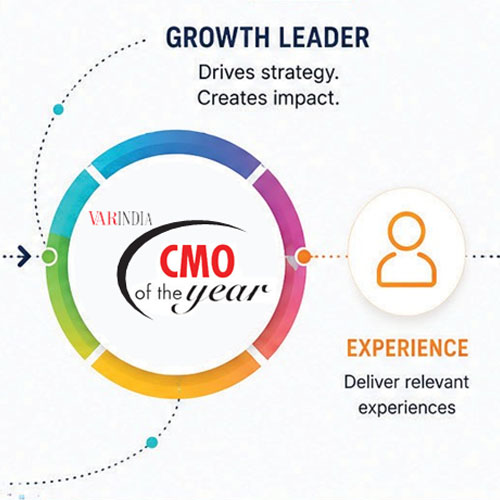
The role of the Chief Marketing Officer (CMO) is being fundamentally redefined. Once focused primarily on advertising, communications and brand visibility, today’s CMO is emerging as a growth architect, customer champion, technology strategist and guardian of brand trust. Marketing leadership is increasingly expected to influence revenue, customer experience and corporate strategy while demonstrating measurable business outcomes.
At the center of this transformation is data-driven intelligence. Organizations have access to unprecedented volumes of customer, behavioral and market data, but competitive advantage comes from converting that information into actionable insights. The modern CMO must understand customer needs, anticipate changing preferences and connect marketing investments directly with acquisition, retention, pipeline, profitability and customer lifetime value. Marketing is therefore moving from measuring campaigns to influencing enterprise growth.
Artificial Intelligence is accelerating this transformation. AI is reshaping personalization, content creation, predictive analytics, customer engagement and campaign optimization. This makes AI literacy a leadership requirement for CMOs. They must understand how AI systems use customer data, what outcomes they optimize, where bias or inaccuracies can emerge and when human intervention is necessary. The challenge is to combine the speed and intelligence of AI with human creativity, judgment and brand understanding.
At the same time, the CMO is becoming the custodian of customer experience and Trust. Customers interact with brands through websites, social media, marketplaces, physical locations, partners and AI-powered platforms. Creating a consistent experience across these touchpoints requires personalization, but personalization must respect privacy. Consent, transparent data usage, responsible AI and cybersecurity are therefore becoming integral to marketing strategy. The strongest brands will be those that use customer intelligence without compromising customer confidence.
The new-age CMO must consequently collaborate closely with the CEO, CIO, CISO, Chief Data Officer, sales teams and channel ecosystem. For technology companies, this responsibility extends to distributors, VARs, system integrators, MSPs and other partners. Partner enablement, joint campaigns, demand generation and transparent engagement can transform the channel into a powerful growth engine. The CMO increasingly connects brand, technology, sales, customer experience and partnerships across the enterprise.
Ultimately, tomorrow’s successful CMO will evolve from Campaign Manager to Business Growth Leader and from Data Collector to Insight Creator. The new marketing equation transforms Data into Insight, Insight into Experience, Experience into Trust, Trust into Revenue, and Revenue into sustainable Growth.
-----------------------------------------------------------------------------------------------------------------------------------------
CP PLUS Leverages Data and AI to Drive More Relevant Customer Engagement
ADITYA KHEMKA
Managing Director CP PLUS
Evolving Marketing Strategy for the AI Era
The role of marketing is changing as rapidly as the technology it represents. For CP PLUS, the shift is from simply showcasing surveillance products to shaping the conversation around the future of security. AI gives us an opportunity to move from feature-led communication to insight-led storytelling—showing customers not just what a solution does, but what it enables.
This means building stronger category narratives around intelligent security, connected infrastructure, proactive protection and the convergence of physical and digital security. It also means creating different conversations for different stakeholders—from enterprises and government institutions to system integrators, installers and consumers.
Our marketing is consequently becoming more experiential and participative. Technology showcases, World Experience Centers, regional events, digital content, partner programmes and industry thought leadership allow customers to experience innovation rather than merely hear about it.
The larger ambition is to make CP PLUS not merely a company that markets security technology, but a brand that helps define where the industry is heading—and creates commercial opportunities by taking customers and partners along that journey.
Technology-driven Trust, Partner Ecosystems, and Customer Experience
The opportunity with data is to replace generic engagement with relevance. We are increasingly using insights from digital interactions, campaign performance, product interest, and regional behaviour to understand what different audiences are looking for and tailor our communication accordingly.
AI also allows us to make the technology story itself more tangible. Instead of positioning AI as an abstract promise, our marketing increasingly demonstrates specific applications—from intelligent detection and analytics to automation and smarter decision-making. This helps customers understand value in operational terms.
For our partner ecosystem, digital platforms provide an opportunity to extend enablement beyond physical interactions. Product education, technical content, training, campaign assets, and business-development communication can reach partners faster and more consistently, while feedback from the ecosystem can flow back into our marketing and product strategy.
Customer experience is being approached similarly. Every digital touchpoint, from discovery and education to product evaluation and post-sale engagement, needs to feel connected. Trust ultimately comes from consistency: saying the right thing, demonstrating it transparently, and delivering the experience promised. Data helps us understand the customer better; digital channels help us respond faster; and AI helps us make the conversation more intelligent.
----------------------------------------------------------------------------------------------------------------------------------------
Driving Marketing Through Data, AI and Customer Insight
ANIMESH ROLA
Head of Marketing Iris Global Services
Evolving Marketing Strategy for the AI Era
Marketing has evolved significantly from being a support function to becoming a business-driving function. The shift has happened because the marketer today is expected to contribute much beyond brand awareness.
Our approach is therefore increasingly centered around understanding what the customer is saying, what the market is doing, and where the competition is moving before deciding what we should communicate. The objective is not to simply launch more campaigns, but to ensure every campaign has a clear business purpose.
With the availability of data, customer feedback, and digital intelligence, marketing can become far more calculative and outcome driven.
We believe the future belongs to marketers who can combine creativity with commercial understanding. Marketing should not just tell the market what a company does; it should help the company understand what the market wants next.
Technology-driven Trust, Partner Ecosystems, and Customer Experience
We see AI as a tool for execution and augmentation, not a replacement for marketing thinking.
The real opportunity is to use AI to bring a marketer's idea to life faster and better. The idea, the insight, and the understanding of the customer still need human intervention. AI can help us analyze large datasets, identify patterns, personalize communication, accelerate content production, test multiple variations and improve campaign execution. But the marketer still needs to decide what should be said, why it should be said and whether it will actually matter to the customer.
Brand Positioning in Competitive Market
We believe there is an opportunity to make marketing far more calculative. Before launching a campaign, we should have enough intelligence to understand the customer, validate the proposition, study competitive activity, review previous campaign performance, and, wherever possible, get direct customer or partner feedback. These pre-checks don't eliminate risk, but they significantly improve the probability of making the right decision.
This is where data becomes extremely powerful. Instead of asking, “How many people did we reach?”, we should be asking, “What did we learn? Did the audience show intent? Did the message influence behavior? Did it create an opportunity for sales? What should we change next?” For us, differentiation is therefore not about having the loudest campaign. It is about having a better understanding of the market and acting on that understanding faster than the competition.
--------------------------------------------------------------------------------------------------------------------------------------
Xvantage Powering Partner Growth
ANKESH KUMAR
Chief Marketing Officer Ingram Micro India
Evolving Marketing Strategy for the AI Era
The fundamentals of marketing have not changed with AI — understand your customers, be present where they are, and give them a compelling reason to engage with you. What is changing dramatically is our ability to execute these fundamentals with greater intelligence, speed and relevance.
Our focus is therefore not on using AI simply because it is the latest technology trend, but on using technology to make marketing more meaningful for our partners and customers. That means sharpening our content and value propositions, becoming more contextual to different partner segments, and delivering the right engagement through the right channel at the right time.
AI and data allow us to understand intent better, personalize engagement at scale, accelerate content development and continuously optimize campaigns based on outcomes.
Technology-driven Trust, Partner Ecosystems, and Customer Experience
We look at AI much more broadly than just using Generative AI for content creation or customer targeting. Those capabilities are increasingly becoming hygiene factors for modern marketing organizations. The bigger opportunity is embedding AI into the way we operate, transact and create value for our partners.
A good example is Xvantage, our AI-powered digital platform, where AI and data intelligence are built into the experience—helping our associates identify opportunities, provide more relevant solutions and engage customers more effectively.
Brand Positioning in Competitive Market
One of our biggest priorities is accelerating digital adoption and creating greater awareness of how Xvantage can help partners manag11e and grow their businesses more efficiently. We want digital engagement to go beyond transactions and become an enabler of better business outcomes.
A second priority is expanding our engagement with the SMB ecosystem and partners across Tier 2 and Tier 3 cities and emerging technology markets. India’s technology opportunity is becoming increasingly distributed, and we want to make Ingram Micro's portfolio, capabilities, services and expertise more accessible to partners wherever they operate.
The third area is transforming the role of marketing itself. Our ambition is to increasingly position Ingram Micro Marketing as a Marketing-as-a-Service capability for the ecosystem.
That means bringing together To-Channel, For-Channel and Through-Channel marketing—helping technology providers reach and activate partners, helping partners build their own marketing capabilities, and enabling joint programs that ultimately reach end customers.
----------------------------------------------------------------------------------------------------------------------------------------------
Blackstraw Shifts from Broad Campaigns to Trust- and Insight-Led Marketing
HEMENDHIRA MURALIDHARAN
Vice President- Marketing Blackstraw
Evolving Marketing Strategy for the AI Era
Marketing today is all about trust and relevance. Buyers are 60-70% of the way to a decision before they ever decide to partner with a vendor, courtesy LLMs. As AI reshapes buyer expectations, our strategy has moved from sending broad campaigns to sending personalized, insight-driven engagement across every touchpoint.
We use expert human inputs in deciding which challenges need to be tackled first, guided by where clients are actually feeling the pain. We use AI to accelerate content creation, uncover customer insights, and support account-based marketing. So, the content you see is anchored in highlighting measurable outcomes. At the same time, authentic human storytelling and founder-led thought leadership remain our biggest focus.
Technology-driven Trust, Partner Ecosystems, and Customer Experience
In enterprise AI, nobody trusts a claim anymore. They trust evidence. So, we lean on data analytics first to see where clients are genuinely seeing impact, and let that tell us what to say, instead of deciding the message and hunting for proof later. AI helps us personalize at scale, but we're careful not to let that scale wash out the human voice in what we develop.
On the digital side, we've stopped chasing volume. We'd rather put one sharp, relevant proof point in front of the right decision-maker than blast a hundred people with something generic. Customer experience starts with being understood. If someone can't quickly grasp the problem we solve, no amount of digital marketing can fix that.
Brand Positioning in Competitive Market
Enterprises look for five things: trust, credibility, accountability, capability, and delivery strength. Capability alone doesn't differentiate anyone anymore. Every AI company claims GenAI, Agentic AI and automation expertise now, so these words have stopped meaning much. What we're really betting on is accountability. At Blackstraw, internally we run on a principle we call "Say: Do," and we want people outside the company to see that same discipline: in our case studies, in our slide decks, and in how our clients' outcomes actually play out, including being upfront about where AI still falls short.
We're also going deeper rather than wider in every industry vertical: retail, CPG, manufacturing, market research, financial services, supply chain, logistics, healthcare, and aerospace. Being specific and targeted earns credibility faster than trying to be the generalist AI vendor for everyone.
----------------------------------------------------------------------------------------------------------------------------------------
Druva Positions AI Resilience as the Next Frontier of Enterprise Data Protection
JACQUELINE FRANKISH
International Senior Marketing Director
Field Channel & Alliances Druva
Evolving Marketing Strategy for the AI Era
Our marketing is becoming much more focused on relevance, revenue and real customer challenges. AI is helping us work smarter — from brainstorming campaigns and content to identifying trends, challenges and audience segments.
For international marketing, that is particularly important. What resonates in the UK may be very different in India, ASEAN or EMEA, so we use data and AI to help us understand those differences while keeping a consistent Druva story.
Our move towards AI Resilience for the Enterprise is a great example. As AI becomes embedded in businesses, organisations need to think about the new risks around their data, security and resilience. We want Druva to be part of that conversation and help customers understand what resilience needs to look like in an AI-driven world.
Technology-driven Trust, Partner Ecosystems, and Customer Experience
We use AI and data as tools to help us make better decisions and move faster. AI helps with everything from campaign brainstorming and content creation to spotting trends and identifying where we may need to change our approach.
Data tells us what is actually working — from engagement and MQLs through to opportunities, pipeline and bookings.
Digital channels, content syndication and targeted campaigns allow us to reach audiences at scale, while nurture and reactivation programmes help us continue conversations rather than constantly starting from zero.
For our partners, it's about making marketing easier and more commercially valuable — giving them the content, campaigns and enablement they need to engage their customers and generate their own pipeline.
Brand Positioning in Competitive Market
For me, it comes down to three things: relevance, partners and results.
We need to understand what customers are struggling with and make sure our messaging addresses those challenges. AI Resilience is a good example — it connects a major market trend with a genuine business risk.
Our partners and MSPs are also fundamental to our growth. We want to build programmes where Druva and our partners both win, helping them create demand and grow their businesses alongside ours.
And finally, marketing has to prove its value. We look beyond activity and leads to opportunities, pipeline and revenue. AI can help us be faster and smarter, but ultimately it's about combining technology with human insight, creativity and a strong understanding of our markets.
-------------------------------------------------------------------------------------------------------------------------------------------
From Linear Journeys to Intelligent Engagement: SAS’s Marketing Evolution
KUNAL AMAN
Director- Marketing & Communications
Middle East, Turkiye Africa & India SAS
Evolving Marketing Strategy for the AI Era
Marketing today operates in a far more dynamic environment where customer expectations, buying journeys, and technology adoption patterns are constantly evolving. As a result, our strategy has shifted to deliver more relevant, industry-focused and outcome-driven experiences across the lifecycle. Rather than taking a broad-based approach, we increasingly tailor our engagement around the specific opportunities, challenges and priorities of the industries we serve.
The traditional, linear path from awareness to consideration and purchase has become far less predictable. Customers are influenced by a wide range of interactions across digital channels, peer networks, industry communities, search, AI-powered experiences, and real-world conversations. Our focus is therefore on creating consistent, valuable engagement throughout the customer journey, recognizing that influence often happens long before it can be directly measured or attributed.
AI is playing an increasingly important role in helping us achieve this. At the same time, we continue to balance technology with human understanding. Another important evolution has been closer alignment across sales, customer success, and partner teams. Growth today is a shared responsibility, and marketing has a critical role in connecting these functions through consistent narratives, actionable insights, and coordinated engagement strategies.
Technology-driven Trust, Partner Ecosystems, and Customer Experience
From a brand perspective, trust remains one of the most important differentiators, particularly in today’s era of AI. With an emphasis on transparency, consistency, and demonstrated outcomes, these pillars ensure digital channels enable meaningful conversations with our stakeholders.
Our partner ecosystem is equally important. Technology innovation increasingly happens through collaboration, and marketing plays a key role in bringing together customers, partners, and industry communities around shared opportunities. By leveraging data-driven insights, we can better identify areas of mutual value, support joint go-to-market initiatives, and create stronger ecosystem engagement.
When it comes to customer experience, we use AI and analytics to better understand customer needs, anticipate challenges, and deliver more personalized interactions. This enables us to engage with greater relevance while ensuring that every touchpoint reinforces the trust and credibility that customers expect from us. The goal is to build lasting relationships that drive long-term value for both customers and the business.
---------------------------------------------------------------------------------------------------------------------------------------
From Backup to AI Trust: Veeam’s New Marketing Vision
KUSHAGRA SHARMA
Director and Head of Marketing India and SAARC Veeam Software
Evolving Marketing Strategy for the AI Era
At Veeam, our evolution has been from campaigns and communications towards becoming a growth engine that is accountable for outcomes across the customer lifecycle.
Our starting point remains human-first. We first understand the customer’s pain points, business priorities and the challenges they are trying to solve, rather than immediately positioning a solution. AI and data then help us scale that understanding through deeper insights, hyper-personalisation and more agile customer journeys. AI is an amplifier of human intelligence and creativity, not a substitute for either.
This becomes particularly important as enterprises move from experimenting with AI to deploying agentic AI. Veeam’s shift towards becoming the Data and AI Trust Company reflects this changing landscape, with trust, resilience and governance becoming critical to responsible AI adoption. The same principle applies within our own marketing organisation. We are increasingly looking at AI not simply as a tool for faster content creation, but as a way to redesign repeatable workflows, automate low-value tasks and give teams more time for strategic thinking and creativity.
Ultimately, I believe marketing has to move beyond visibility and vanity metrics. We look at brand equity, customer lifetime value, marketing ROI, pipeline, retention and renewals. Growth is important, but sustainable growth comes from earning customer trust and building relationships that last.
Brand Positioning in Competitive Market
Our first priority is to sharpen Veeam’s market narrative as it evolves into the Data and AI Trust Company. We want to move beyond the traditional backup and recovery conversation and build stronger associations with data resilience, trust and confident AI adoption, while making these themes relevant to customers, partners and the wider ecosystem. As the category becomes more complex, clarity itself becomes a differentiator. Customers need a simple way to understand what matters, particularly as data resilience increasingly converges with security, governance and AI.
The second priority is commercial accountability. Marketing needs to demonstrate a clear connection to business performance, which means looking beyond visibility metrics to marketing ROI, customer lifetime value, pipeline, revenue contribution, retention and renewals. At the same time, I believe sustainable growth comes from loyalty and renewals rather than simply chasing one-off wins.
The third is to use marketing as a platform for ecosystem impact and industry influence. Through initiatives such as Bharat CyberSuraksha and the DSCI partnership, we can engage with broader conversations around cyber resilience, data governance and secure AI adoption.
-----------------------------------------------------------------------------------------------------------------------------------------
From Technology to Outcomes: A Customer-Centric Marketing Strategy
LAKSHMI VIKRAM
Marketing & Communications MEITA
(Middle East India, Turkey & Africa) Alcatel-Lucent
Evolving Marketing Strategy for the AI Era
At Alcatel-Lucent, our marketing strategy is becoming increasingly customer-centric and insight-driven. Rather than focusing on technology alone, we focus on the business outcomes customers are looking to achieve, whether that is improving operational efficiency, enabling hybrid work, or accelerating digital transformation.
Our purpose remains unchanged: to make everything connect (people, devices and processes) in a way that is human, secure and sovereign. AI is how we bring that to life, both in the products we build and in the way we take them to market.
In our portfolio, AI removes the complexity that has always sat between an IT team and its network. Our platforms can be managed, configured and operated in natural language: the administrator describes the intent, the system turns it into configuration. AI then analyzes network behavior, traffic and bandwidth usage as well as where anomalies appear, and recommends the corrective action instead of leaving a team to interpret raw data. For a hospital, a school district or an airport running a lean IT team, that changes what a handful of people can operate and secure.
Alongside these capabilities, we continue to focus on thought leadership, customer success and partner-led initiatives that demonstrate real-world value. For us, meaningful engagement is built on relevance and trust, not simply reach.
Technology-driven Trust, Partner Ecosystems, and Customer Experience
AI and data analytics are enabling us to make smarter marketing decisions while creating more personalized experiences for customers and partners. We use data to better understand audience interests, optimize campaign performance, and deliver timely, relevant communications across digital channels.
AI is also changing how the marketing organization operates. We are automating repetitive parts of our workflows: campaign setup, lead routing and scoring, reporting, asset versioning and approval cycles.
Equally important is our partner ecosystem. Our partners play a critical role in bringing our solutions to market, so we work closely with them through joint marketing initiatives that help deliver consistent customer experiences. Across these initiatives, transparency, security, and customer trust remain fundamental.
-----------------------------------------------------------------------------------------------------------------------------------------
Beyond the Threat: Sophos' Outcome-Led Marketing Strategy
MEHUL THAKKAR
Sr. Manager Marketing India & SAARC
Sophos
Evolving Marketing Strategy for the AI Era
Our marketing strategy is evolving from broad product-led communication to a more outcome-led, insight-driven approach that helps customers understand how AI is changing both the threat landscape and the way cybersecurity can be delivered. The focus is on connecting Sophos’ technology story to clear business priorities: reducing cyber risk, simplifying security operations, improving resilience and enabling organisations to adopt AI with greater confidence.
In practical terms, this means using market insights, customer pain points and Sophos threat intelligence to shape campaigns that are more relevant to different audiences, from CISOs and security practitioners to business decision-makers and channel partners. Rather than simply promoting AI as a feature, our marketing explains how AI-native capabilities such as Sophos Fusion can help create a more connected security architecture across endpoint, network, email, cloud, identity, XDR and MDR.
For India and SAARC, the approach is also becoming more localised and partner-centric. We are developing data-led content, digital engagement and channel marketing that translate Sophos’ global AI and cybersecurity proposition into locally relevant business conversations.
Technology-driven Trust, Partner Ecosystems, and Customer Experience
AI, data analytics and digital channels are helping us make marketing more relevant, responsive and useful for customers and partners. In cybersecurity, trust is earned by showing that we understand the risks organisations are facing and can help them respond with confidence. That is why we use insights from Sophos threat intelligence, customer behaviour and campaign performance to shape sharper, more timely engagement.
For customers, this means delivering the right guidance through the right channels, from practical threat education to outcome-led content that helps business leaders and security teams make informed decisions. For partners, especially in India and SAARC, it means better enablement, stronger co-marketing and more localised conversations that support customer growth.
Brand Positioning in Competitive Market
• Focus on measurable outcomes: We focus on demonstrating tangible outcomes such as stronger prevention, faster detection and response, reduced complexity and better cyber risk management.
• Strengthen local relevance: Our messaging needs to reflect the realities of the local market, including regulatory requirements, technology environments, buying journeys and digital maturity.
• Enable our partner ecosystem: We continue to invest in training, co-marketing, technical support and localised resources to help partners deliver greater value to customers
Also, our priority is to differentiate Sophos through the value we deliver, combining strong technology, actionable intelligence, market relevance and a well-enabled partner ecosystem to drive measurable customer outcomes and sustainable growth.
-------------------------------------------------------------------------------------------------------------------------------------------
Asus India Looking at Marketing Performance Beyond Traditional Measures
PARAMJEET SINGH MEHTA
Product and Marketing Head Consumer and Gaming Business ASUS India
Evolving Marketing Strategy for the AI Era
Our marketing strategy is evolving from being primarily product-led to becoming much more use-case-led. As AI becomes an increasingly important part of the technology experience, consumers are keen to know more beyond specifications alone and develop an understanding of how these capabilities can solve different daily tasks and requirements, whether that is improving productivity, enabling creativity, enhancing gaming and entertainment, or making everyday computing more seamless and mobile.
At the same time, we are looking at AI as an ecosystem story rather than simply a hardware proposition. ASUS is part of a broader AI PC ecosystem that brings together devices, applications and experiences. Our role as a technology brand is to make that ecosystem tangible and show consumers what they can actually do with AI rather than simply telling them that a device is AI-enabled.
This also means making our communication more relevant to different audiences. A student, creator, professional, gamer or first-time PC buyer will have very different expectations from AI, and our messaging needs to reflect those distinct use cases and motivations.
Considerably, experiential marketing is becoming an important part of this approach. Through retail demonstrations, hands-on experiences, influencer-led content and initiatives such as ASUS Live, Spotlight and ProArt Live, we can allow consumers to experience AI capabilities first-hand, both virtually and physically. Ultimately, the role of marketing is not just to generate awareness, but to move consumers from understanding the technology to considering it and experiencing its value.
Brand Positioning in Competitive Market
Our priority is to create clear differentiation across our portfolio, with each product line having a distinct consumer proposition.
At the brand level, we also want to strengthen ASUS perception as a technology and innovation leader while making that innovation accessible to a wider range of consumers across price segments. Differentiation today is not only about having advanced technology; it is about making that technology relevant and accessible to different consumer groups. Retail excellence is another key priority because the last mile can have a significant influence on the purchase decision. We are focused on strengthening the in-store experience through better-trained ASUS Solution Experts, stronger product visibility, hands-on demonstrations and clearer communication around financing and offers. India-specific relevance also means ensuring that technology is accessible beyond the largest cities. Ultimately, we are looking at marketing performance beyond traditional measures such as reach and awareness. The focus is on whether our efforts are improving consideration, driving engagement and retail footfall, generating quality leads and contributing to conversion and sustainable business growth.
------------------------------------------------------------------------------------------------------------------------------------------
Kaspersky Scales AI While Keeping Human Judgement at the Core
PIYUSH KUMAR
Marketing Manager Kaspersky
Evolving Marketing Strategy for the AI Era
On the product-messaging side, our language is shifting from generic "AI-powered protection" claims to being specific about the detection layers actually doing the work.
On the marketing operations side, AI is changing three things for us. Instead of one nurture track per persona, we can build content paths based on a prospect's vertical, company size, and stage in the buying cycle, across web, email, and ad creative. Second, for account-based marketing, AI-assisted intent and firmographic signals help us prioritize where sales and marketing effort actually goes, instead of running one broad campaign at everyone. Last, AI can also be used to pilot experiences at trade shows and owned events.
But none of this replaces judgment. AI can suggest a next-best asset, but it can't decide what claim is defensible in front of a CISO. In fact, I feel judgement has more value now since some parts of execution can be automated by AI.
Technology-driven Trust, Partner Ecosystems, and Customer Experience
In the content pipeline, AI compresses the first-draft stage rather than replacing judgment — threat research summaries, first-pass social copy, and meeting notes turned into follow-up briefs are AI-assisted now, which frees the team to spend more time on strategy and message calibration instead of drafting from a blank page. On the analytics side, predictive lead scoring, so sales teams prioritize accounts with real buying signal instead of working through raw lead volume, also helps. But especially for the latter, the tools are only as good as the data feeding them.
Brand Positioning in Competitive Market
Mindshare is deliberately the first one. India's enterprise and government security market has more vendors competing for the same budgets than most CISOs can realistically evaluate. Being remembered and trusted by the time a shortlist gets built matters as much as any single campaign.
The second is vertical specificity. "Enterprise cybersecurity" isn't one buyer — a BFSI CISO, a manufacturing OT security lead, and a government PSU IT head care about different threats, different compliance pressure, and different proof points. We're moving away from one-size-fits-all messaging toward vertical-specific narratives, and this is especially relevant now that India's data protection framework is speeding up.
---------------------------------------------------------------------------------------------------------------------------------------------
From Promoting Products to Orchestrating Growth
PUNEET CHADHA
Global Chief Marketing Officer, Redington
Evolving Marketing Strategy for the AI Era
The most important change is not simply the use of AI in marketing. It is the transformation of marketing’s role in an AI-driven enterprise.
Marketing can no longer operate as the communication layer that enters after the business strategy has been decided. It must help identify growth opportunities, shape the go-to-market model, mobilise the partner ecosystem and connect every marketing investment to a measurable customer or business outcome.
At Redington, our strategy is evolving from promoting products to orchestrating growth. Our enduring purpose is to reduce technology friction, while our Unlock Next-Orchestrating Growth Across the Technology Ecosystem positioning expresses how we bring that purpose to life. We connect technology brands, channel partners, ISVs, hyperscalers, customers, platforms, services and market intelligence so that innovation becomes accessible, understandable and deployable.
There are four important shifts within this strategy.
• Demand Generation at Scale - AI and analytics allow us to move from broad campaigns to intelligent, account- level engagement. We can combine market intelligence, behavioural signals, third-party intent data and historical performance to identify which accounts are showing an inclination to buy, what business problem they may be trying to solve, and which partner is best positioned to engage them. AI can help personalise communication, optimise media and accelerate lead qualification, while integrated lead assignment and sales feedback create a closed loop from engagement to opportunity and closure. The objective is not to produce more leads. It is to produce better opportunities, improve conversion velocity and enable our sales and partner teams to have more relevant conversations.
• Corporate storytelling to ecosystem storytelling - Through Unlock Next, the partner and customer become the heroes of the story. Technology matters, but what people remember is the hospital that improved patient care, the manufacturer that reduced downtime, the small business that reached a new market or the channel partner that built an entirely new services practice. Our role is to make these stories visible and repeatable across the ecosystem.
• Democratising marketing capability - Many capable channel partners have deep customer relationships but may not possess sophisticated marketing teams, automation platforms or content studios. Through Marketing-as-a- Service, structured partner-growth programmes, joint demand generation and smarter deployment of market- development funds, we can give them access to strategy, content, campaigns, analytics and lead generation as a shared capability. MDF must increasingly be treated as growth capital, not merely as reimbursement for completed activities.
• Connecting digital engagement with physical experience - AI cannot be understood only through presentations. It must be experienced. Our AI Exchange, Academy, digital platforms and planned AI experience centers and launchpads are intended to help partners move through a practical journey: discover a use case, see it working, build capability, engage a customer and scale the solution. For me, the most inspiring possibility is democratisation. A partner serving customers in a Tier-2 or Tier-3 city should not feel that the AI revolution is happening somewhere else. That partner should be equipped to become the most trusted AI adviser in the local market. The real test of technology leadership is not how many people are impressed by AI. It is how many people are empowered by it.
---------------------------------------------------------------------------------------------------------------------------------------------
AI Becomes Cyble’s Marketing Engine for Smarter Demand and Buyer Engagement
RAJASHAKHER INTHA
Head of Global Marketing Cyble
Evolving Marketing Strategy for the AI Era
We have made a deliberate shift from a visibility-first playbook to a decision-first strategy. In threat intelligence, commoditization is the enemy - everyone claims real-time, predictive, and autonomous. The differentiator is no longer how much intelligence you surface, but how effectively you help security teams act on it.
Visibility still matters. What it has to achieve has changed. It should create credibility, consideration, and pipeline - not traffic and engagement metrics.
Our strategy is built around helping security leaders move faster from threat detection to business impact. That means positioning Vision and Blaze as decision engines rather than data feeds, and Titan as endpoint defense built on silicon attestation rather than another agent on the stack. Different capabilities, same underlying promise: reduce risk with more speed and more confidence.
Technology-driven Trust, Partner Ecosystems, and Customer Experience
AI is not a layer we added to marketing. It is how the function runs.
AI as evidence, not adjective: Our threat telemetry and research data feed original benchmarking, threat landscape reporting, and customer-facing insight. AI helps us process that volume at a speed no analyst team could match - clustering campaigns, surfacing sector-level patterns, translating raw intelligence into narratives a CISO can take to a board.
AI in the demand engine: We use AI across the funnel - ICP scoring and account prioritization, intent signal enrichment, campaign performance analysis, and content variant testing at a scale manual workflow cannot support. It compresses the loop between what the market responds to and what we produce next. The judgment stays human. The throughput is machine-assisted.
Optimizing for how buyers actually search now: A growing share of the enterprise buying journey starts inside AI assistants rather than a search bar. We treat answer engine visibility as core infrastructure - structured data, entity consistency across knowledge sources, and content built to be cited accurately when a security leader asks an AI system how to evaluate a threat intelligence platform. If the machine reading the market gets Cyble wrong, the buyer does too.
Partners as a growth engine: We are expanding beyond traditional channel relationships into deeper integrations across SOAR platforms, MDR providers, MSSPs, and other security ecosystems. These partnerships extend reach while making Cyble more relevant inside the workflows customers already use.
----------------------------------------------------------------------------------------------------------------------------------------
Everpure Moves Beyond Storage to Build an AI-Ready Data Infrastructure Narrative
RIMI DAS
Head of Marketing India Region Everpure
Inc. (formerly Pure Storage)
Evolving Marketing Strategy for the AI Era
Marketing is no longer measured simply by leads, events or campaign reach. The focus is shifting toward pipeline contribution, customer acquisition, expansion, retention and revenue impact. Every marketing investment needs a clear connection to business priorities. The conversation is moving beyond "storage" toward the bigger enterprise challenges: AI readiness, data infrastructure, cyber resilience, modernisation, sustainability and data sovereignty. This positions Everpure as a strategic technology partner rather than simply a storage vendor.
AI enables marketing to understand customer behaviour, intent and business priorities at a much deeper level. The objective is to deliver the right insight, to the right persona, at the right moment—rather than pushing generic campaigns. This matters because we increasingly see unified data as the foundation for personalised, two-way engagement.
Technology-driven Trust, Partner Ecosystems, and Customer Experience
For India, we translate that intelligence into a highly localized, digital-first customer experience. We use digital channels, account intelligence, content personalization, social engagement, webinars, executive programs and targeted campaigns to meet customers where they are—whether the conversation is around AI, cyber resilience, modernization or data analytics.
In an AI-driven market, customers don't need more technology messaging—they need evidence, expertise and outcomes. So our content strategy increasingly focuses on customer stories, industry proof points, executive thought leadership and practical AI and data insights rather than simply talking about products.
Brand Positioning in Competitive Market
Position Everpure as a strategic data and AI infrastructure partner, moving the conversation from storage specifications to outcomes such as faster AI adoption, cyber resilience, operational simplicity, agility and lower TCO.
Develop industry-specific thought leadership, executive conversations and customer proof points that establish Everpure as an AI-ready data infrastructure leader.
Shift marketing measurement from registrations, impressions and event attendance toward pipeline contribution, MQL-to-SQL conversion, influenced revenue, new-logo acquisition and customer expansion.
Scale joint GTM programs with strategic partners and technology alliances.
The priority is to make Everpure the most credible and differentiated data infrastructure brand for the AI era in India - while turning that brand preference into measurable pipeline, customer acquisition, partner growth and revenue.
--------------------------------------------------------------------------------------------------------------------------------------------
SUSE Focuses on Building an AI-Ready Partner Ecosystem for Scalable Growth
SACHIN VIG
Director-
Strategic Channels & Alliances (Indian Subcontinent)
SUSE
Evolving Marketing Strategy for the AI Era
In today's AI-centric landscape, our growth strategy extends beyond simple marketing; it is fundamentally a go-to-market imperative. We operate on a 100% indirect model, and our partners are the force multiplier that lets us engage customers at scale across five distinct routes to market, from resellers and cloud marketplaces to MSPs and ISVs.
As AI moves from experimentation to real deployment, we're seeing customers lean harder into partners who can offer AI-ready, GPU-backed infrastructure, so our strategy has shifted toward enabling and certifying that ecosystem rather than just broadening our reach. It's less about chasing volume and more about backing the 20% of partners who drive 80% of outcomes with the right skills and tools to have credible AI conversations with customers.
Technology-driven Trust, Partner Ecosystems, and Customer Experience
Trust, for us, starts with compliance and openness. We're EAL4++ certified, and with India's DPDP Act coming into effect next year, data sovereignty has become a real differentiator. Customers want infrastructure that keeps their data private and auditable, and our open, non-proprietary architecture is built for exactly that.
On the partner side, we invest heavily in enablement, training, and certifying engineers in DevOps and DevSecOps, because while there is a big appetite for open source in the market, enterprises are equally requiring skilled hands to implement it. That combination of regulatory readiness and partner capability builds durable trust with customers, more than any single marketing channel.
Brand Positioning in Competitive Market
Openness is our sharpest differentiator. SUSE's integrated portfolio, spanning Linux, Kubernetes, and Edge solutions, empowers enterprises to build, deploy, and manage AI-driven applications with consistency and scale. In a market still dominated by proprietary lock-in, we give customers the freedom to choose their own stack, their own LLMs, and their own path, without being tied to a single vendor. Beyond that, our ecosystem priorities for the next 12-18 months are about deepening our presence in BFSI, manufacturing, government, and PSUs- the verticals with the clearest near-term demand and expanding into 15-20 additional tier 2 and tier 3 cities to capture growth beyond the metros.
On outcomes, we're pushing every AI conversation from proof-of-concept to production via initiatives like the SUSE AI Factory with NVIDIA, because that's ultimately what customers and the market will measure us on: not pilots, but tangible results.
---------------------------------------------------------------------------------------------------------------------------------------------
Vertiv India Leverages AI to Drive Infrastructure Efficiency, Uptime and Customer Value
SHRIRANG DESHPANDE
General Manager- Strategic Planning Vertiv India
Evolving Marketing Strategy for the AI Era
At Vertiv India, we follow a customer-centric go-to-market approach tailored to each segment's needs. We engage directly with large enterprises, telecom operators, and colocation providers to understand their infrastructure requirements and deliver solutions aligned with their business outcomes. For mid-market enterprises, we leverage a channel-driven strategy, working closely with system integrators and partners to extend our reach and deliver measurable value at scale.
Technology-driven Trust, Partner Ecosystems, and Customer Experience
AI is embedded across how we build, support, and communicate around our infrastructure. We have developed sovereign AI models built to support our business context, improving internal productivity, customer response times, and the quality of technical collateral our teams produce.
On the services side, Vertiv Next Predict applies AI-powered predictive maintenance through continuous equipment monitoring and anomaly detection to flag early deviations from expected performance. Root cause analysis prioritizes response based on operational risk. Rather than replacing service engineers, it provides them with earlier, more precise signals to act on. This builds trust with partners and customers through predictability and uptime backed by data.
We are implementing next generation AI analytics tools to improve efficiency metrics like time to first token for deployment speed and tokens per watt as compute density in AI infrastructure continues to rise. Visual AI for quality control improves productivity and cycle time. Across all of this, the goal remains consistent: use data to make infrastructure more predictable and support decisions with evidence, not projections.
Brand Positioning in Competitive Market
We differentiate through four core priorities. First, we design converged infrastructure solutions that span field to factory rather than addressing each domain separately. Second, we develop reference architectures aligned with current and anticipated silicon generations, ensuring designs remain relevant as compute requirements evolve. Third, we adapt our offerings rapidly for new silicon generations, directly supporting faster deployment and improved performance. Fourth, we continuously optimize our capacity footprint and supply chain to deliver reliable, on-time fulfilment.
These priorities converge on a single differentiator: consistency. We design for what's coming and back that commitment with the supply chain discipline and operational execution to deliver.
-------------------------------------------------------------------------------------------------------------------------------------------
Beyond Specifications: Acer’s Strategy to Build a Stronge Technology Brand
SOORAJ BALAKRISHNAN
Head of Marketing Acer India
Evolving Marketing Strategy for the AI Era
Our marketing strategy is evolving to keep pace with the way consumers are experiencing technology today. As AI becomes an increasingly important part of the PC experience, we are moving beyond communicating specifications and focusing more on how technology can make a tangible difference to consumers’ everyday lives. Our communication is therefore centred on practical AI use cases, productivity, creativity, gaming and personalisation, making the benefits of AI easier to understand and more relevant to different consumer segments.
At the same time, we are strengthening our digital, social, retail and experiential engagement to create more meaningful interactions with consumers.
We want customers to not just hear about AI, but see, experience and understand its value through our products and content. For Acer, the larger objective is to build a stronger, more contemporary technology brand by combining product innovation with consumer-led storytelling and deeper engagement across the entire customer journey.
Technology-driven Trust, Partner Ecosystems, and Customer Experience
AI, data analytics, and digital channels are helping us make customer engagement more relevant, responsive, and personalised. We are using consumer insights and market data to understand evolving preferences, identify emerging trends and sharpen how we communicate with different audiences. AI is also enabling us to create more engaging content and experiences while helping customers better understand the value that technology can bring to their everyday lives.
Digital platforms also play an important role in strengthening engagement with our partners and creating a more connected ecosystem. By bringing together insights, communication and engagement across digital and physical touchpoints, we can create greater consistency in the customer journey.
Brand Positioning in Competitive Market
Our key priority is to differentiate Acer through a combination of product innovation, meaningful technology experiences and strong consumer relevance. As the PC market becomes increasingly competitive, we are focused on delivering products that address evolving consumer needs across segments, while building stronger differentiation around areas such as AI, gaming, performance, design and mobility. Equally important is ensuring that our brand communication goes beyond product specifications and clearly demonstrates the value and experiences our technology delivers.
From a business perspective, we are focused on turning these efforts into measurable outcomes through stronger consumer engagement, improved product consideration, deeper channel relationships and sustained market growth. We are also placing greater emphasis on data-led decision-making, ensuring that our marketing investments are closely connected to business objectives and that we can measure their impact across the customer journey.
-------------------------------------------------------------------------------------------------------------------------------------------
Epson Embraces AI to Make Marketing More Intelligent, Predictive and Relevant
TUSHAD TALATI
Director-
Brand & Communication Epson India
Evolving Marketing Strategy for the AI Era
AI is changing Epson’s marketing in many ways, and we are looking at different ways to harness its benefits. The first and most obvious is that AI is changing how people discover our brand. People are increasingly asking AI platforms questions rather than simply typing keywords into a search engine. This means our marketing has to think beyond traditional SEO and consider how Epson and our products are represented in AI-generated answers. Being visible and credible in these new search environments has become an increasingly important part of brand building and demand generation.
The creative process is changing too. AI allows us to take a core idea and quickly develop different messages and executions for different audiences.
We operate with a relatively lean marketing team supported by a network of specialist agencies, so AI is also becoming an important enabler in the way we work. We are using it across creative strategy, content, PR, marketing communications, web and technology-related activities.
As we move forward, we are looking to use AI to understand customers better and make better decisions. For example, we want to bring together signals from website behaviour, search, content engagement, CRM and other interactions that previously sat in different places.
If someone is researching high-volume printing, repeatedly looking at cost-per-print information and downloading product specifications, that should tell us much more about their intent than simply knowing they are an SMB customer. We can use those signals to make our communication more relevant and, through Account-Based Marketing, identify high-value businesses and tailor our approach around their specific needs.
The next step is to move from understanding behaviour to predicting it. AI should help us identify which customers may be ready for an upgrade, which prospects are more likely to convert, or where an emerging demand may be developing. That can influence not just marketing, but where sales focuses, which partners we activate and where we invest. It also helps us get closer to measuring marketing by actual business outcomes rather than just clicks, impressions or engagement.
For us, the real opportunity is not simply to make marketing faster. It is to make it more intelligent, more predictive and more closely connected to business growth.
---------------------------------------------------------------------------------------------------------------------------------------------

See What’s Next in Tech With the Fast Forward Newsletter








Tweets From @varindiamag
Nothing to see here - yet
When they Tweet, their Tweets will show up here.