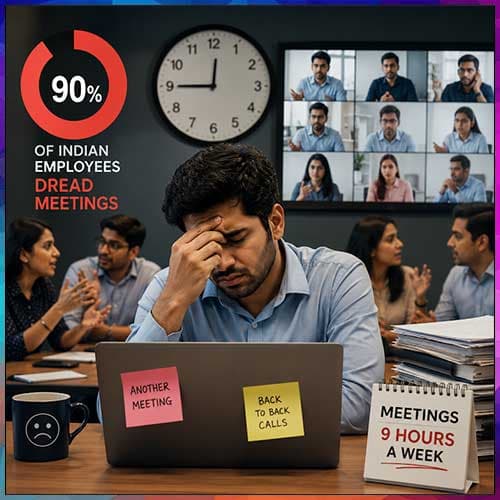
Nine in 10 Indian employees experience some level of meeting dread, while workers spend an average of 8.8 hours a week in meetings, making India one of the most meeting-intensive markets globally, according to a new study by Jabra.
The research, based on a survey of more than 2,300 knowledge workers worldwide, found that poor meeting experiences continue to undermine productivity, collaboration and decision-making as hybrid work becomes the norm across businesses.
The study found that employees believe 58% of meeting time is unnecessary, highlighting a significant productivity drain. Technology problems remain another major challenge, with 75% of hybrid meetings experiencing at least one technical issue that disrupts collaboration.
Meeting effectiveness also remains a concern. Nearly two-thirds (66%) of employees said they leave meetings without clear action items, while 59% said follow-up meetings are often needed to clarify decisions that should have been resolved initially.
In addition, around seven in 10 meetings experience situations where participants cannot be clearly seen or heard, further affecting communication and collaboration.
"India has become one of the world's most collaboration-intensive business environments. Yet our research shows that many employees are spending a significant portion of their workweek in meetings that fail to deliver clear outcomes," said Peter Jayaseelan.
"As organizations accelerate investments in digital transformation and AI, the quality of collaboration is becoming a business-critical issue. Poor audio, technology disruptions, and ineffective meeting experiences don't just affect employees in the moment. They create downstream costs through lost productivity, additional work, and slower decision-making," he said.
The findings come as enterprises increasingly adopt AI-powered workplace tools to improve productivity. However, Jabra said AI alone is unlikely to resolve collaboration challenges if the underlying meeting experience remains poor.
While three-quarters of employees surveyed have experimented with AI meeting tools, fewer than one-third use them regularly. The study suggests that reliable audio, high-quality video and inclusive collaboration remain essential to generating accurate AI outputs and productive meetings.
According to Jabra, organizations need to rethink how meetings are planned, conducted and supported as hybrid work becomes permanent. Improving collaboration quality, the company said, will be critical to boosting productivity, employee experience and business performance in increasingly AI-enabled workplaces.
The research, based on a survey of more than 2,300 knowledge workers worldwide, found that poor meeting experiences continue to undermine productivity, collaboration and decision-making as hybrid work becomes the norm across businesses.
The study found that employees believe 58% of meeting time is unnecessary, highlighting a significant productivity drain. Technology problems remain another major challenge, with 75% of hybrid meetings experiencing at least one technical issue that disrupts collaboration.
Meeting effectiveness also remains a concern. Nearly two-thirds (66%) of employees said they leave meetings without clear action items, while 59% said follow-up meetings are often needed to clarify decisions that should have been resolved initially.
In addition, around seven in 10 meetings experience situations where participants cannot be clearly seen or heard, further affecting communication and collaboration.
"India has become one of the world's most collaboration-intensive business environments. Yet our research shows that many employees are spending a significant portion of their workweek in meetings that fail to deliver clear outcomes," said Peter Jayaseelan.
"As organizations accelerate investments in digital transformation and AI, the quality of collaboration is becoming a business-critical issue. Poor audio, technology disruptions, and ineffective meeting experiences don't just affect employees in the moment. They create downstream costs through lost productivity, additional work, and slower decision-making," he said.
The findings come as enterprises increasingly adopt AI-powered workplace tools to improve productivity. However, Jabra said AI alone is unlikely to resolve collaboration challenges if the underlying meeting experience remains poor.
While three-quarters of employees surveyed have experimented with AI meeting tools, fewer than one-third use them regularly. The study suggests that reliable audio, high-quality video and inclusive collaboration remain essential to generating accurate AI outputs and productive meetings.
According to Jabra, organizations need to rethink how meetings are planned, conducted and supported as hybrid work becomes permanent. Improving collaboration quality, the company said, will be critical to boosting productivity, employee experience and business performance in increasingly AI-enabled workplaces.