


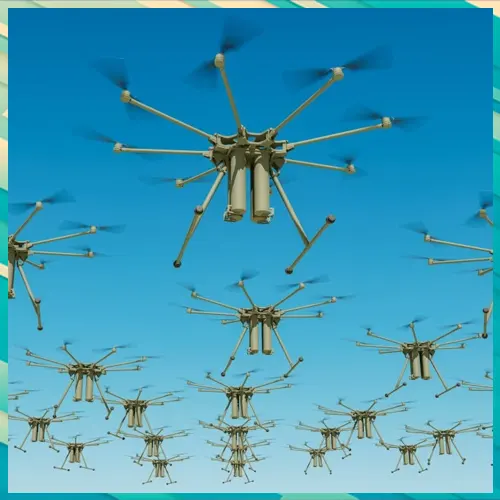
The new defence system employs a 4x4 array of 35mm cannons that fire AHEAD rounds, creating a lethal barrage of sub-projectiles to target small, fast-moving threats like drones, offering a cost-effective alternative to guided missiles in saturation attacks
China’s defence technology landscape is making global headlines once again as Norinco, the country’s state-owned arms manufacturer, unveils what it claims to be the world’s first close-in anti-drone barrage weapon system. Named the “Bullet Curtain,” the advanced defence platform is engineered to combat the rising threat of drone swarms and high-velocity aerial projectiles through a broad coverage, high-volume interception strategy.
Unveiled in the April edition of Modern Weaponry, a journal affiliated with Norinco, the system takes an innovative approach to air defence. Instead of targeting incoming objects individually, the Bullet Curtain generates a dense wall of firepower, intercepting threats across a larger area. According to the system's lead designer Yu Bin, this method ensures higher success in neutralizing fast-moving, coordinated aerial assaults.
“Traditional air defence systems are like throwing stones at a fly—you might miss or hit just one,” said Yu. “Our system is like swinging a fly swatter, covering the entire area where the fly could go.”
At the core of the system is a tightly packed 4x4 formation of 35mm cannons, capable of launching AHEAD (Advanced Hit Efficiency and Destruction) rounds. These specialized shells explode mid-air to release hundreds of sub-projectiles, creating a lethal zone of impact against small, fast-moving targets such as drones. This method is designed to reduce reliance on more expensive guided missiles and enable rapid, repeatable responses to saturation attacks.
Bullet Curtain’s strategic advantages
For higher-value or faster-moving targets like cruise missiles and aircraft, Norinco claims to have developed new types of “serial and parallel” munitions, enhancing the system’s versatility. A multi-layered sensor and fire-control architecture—combining radar, optical tracking, and advanced targeting algorithms—allows the system to dynamically adjust fire patterns depending on the threat's characteristics and trajectory.
Mounted on a road-mobile 6x6 truck chassis, the Bullet Curtain has been developed with a modular design, enabling deployment across a wide range of platforms including naval vessels, fixed bases, and armoured vehicles. This adaptability makes it suitable for a variety of modern battlefield scenarios, from urban defence to front-line protection.
The system’s development was inspired in part by the Metal Storm project, a now-defunct US-Australian rapid-fire weapon concept that failed to become operational. Norinco believes it has overcome those limitations by integrating modern automation, mobility, and advanced ammunition into a cost-effective and scalable package.
China’s answer to drone warfare
Live-fire trials have reportedly demonstrated the Bullet Curtain’s effectiveness in neutralizing drone swarms—a tactic increasingly seen in modern conflicts from the Middle East to Eastern Europe. Drone swarm attacks, due to their low cost and ability to overwhelm traditional defence systems, have become one of the most pressing challenges for military forces worldwide.
“There’s an urgent demand for weapons that can track and neutralize multiple small targets simultaneously,” Yu said. “Our system is capable of large-area coverage, intelligent fire control, and can be deployed quickly across various combat theaters.”
In addition to drones, the system is also designed to engage fixed-wing aircraft, helicopters, mortar rounds, and cruise missiles, offering a broad-spectrum solution for close-range air defence.
With growing concerns over asymmetric warfare and the proliferation of low-cost unmanned aerial vehicles, the Bullet Curtain represents China’s strategic push toward more agile, multi-target air defence capabilities tailored for 21st-century conflicts.
See What’s Next in Tech With the Fast Forward Newsletter









Tweets From @varindiamag
Nothing to see here - yet
When they Tweet, their Tweets will show up here.