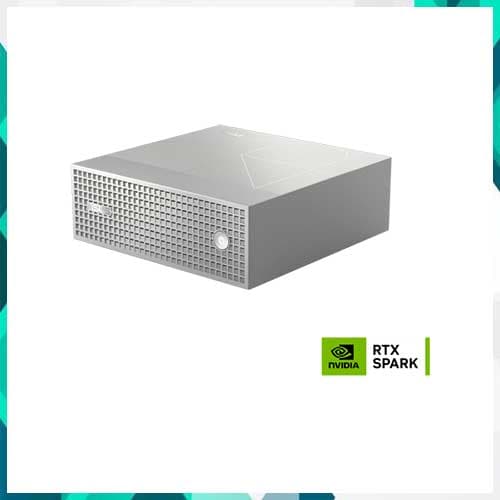
The personal-computing market is heading toward a new competitive battle as ASUS introduces the ProArt GR1X Mini PC, a compact system designed not merely for conventional computing, but for running AI models and personal AI agents locally.
At the heart of the GR1X is NVIDIA’s RTX Spark N1X platform, combining a Blackwell RTX GPU with a Grace CPU. ASUS says the system can deliver up to 1 petaflop of FP4 AI performance, with as many as 6,144 GPU cores and 128GB of unified memory.
Perhaps more significantly, ASUS says the machine can run 120-billion-parameter LLMs locally. Its 150 x 150 x 51mm form factor puts substantial AI computing capability into a device small enough to sit almost unnoticed on a desk.
That changes the competitive equation. PCs have traditionally competed around processors, graphics, memory and gaming performance. The next battle could increasingly revolve around how much AI can be executed locally without depending continuously on cloud infrastructure.
ASUS is positioning the GR1X differently from developer-focused AI workstations. It runs Windows and targets creators, workflow builders, developers and gamers, bringing local AI agents into familiar applications and everyday computing environments.
The competitive field is already expanding. NVIDIA’s own DGX Spark provides 1 PFLOP of FP4 performance and 128GB unified memory, while other manufacturers are entering the compact AI workstation category.
This could create intense competition among ASUS, NVIDIA, Dell, HP, Lenovo, MSI, Apple and emerging AI-hardware companies. With several systems using similar underlying NVIDIA architectures, differentiation will increasingly depend on pricing, operating systems, cooling, storage, software ecosystems, support and AI-agent integration.
The implications extend beyond hardware. Running AI locally can reduce dependence on cloud inference, improve responsiveness and provide organizations greater control over sensitive data. For developers, enterprises and creators, that could fundamentally change the economics of AI deployment.
There will still be limitations. Local machines will not replace hyperscale AI infrastructure for training frontier models or handling massive enterprise workloads. But they can shift substantial inference, prototyping, fine-tuning and agentic workloads from centralized clouds to individual desks.
The GR1X therefore signals something bigger than another mini-PC launch. The PC industry is entering the era of the personal AI supercomputer, where the winning machine may no longer be the fastest traditional computer, but the one capable of running the most useful AI agents privately, locally and economically.