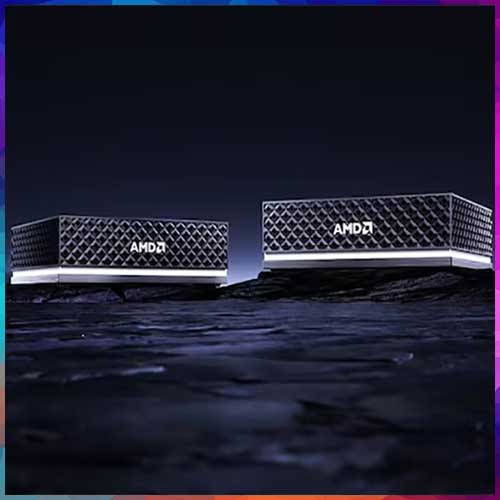
Powered by the Ryzen AI Max+ 395 processor, AMD’s new developer platform can run large AI models on a single machine, offering developers greater control, enhanced privacy and potentially lower computing costs.
AMD has unveiled a new artificial intelligence-focused computing platform aimed at bringing advanced AI capabilities directly to personal devices, reducing the need for cloud-based infrastructure and expensive external computing resources.
The company’s Ryzen AI Halo Developer Platform is designed for developers, researchers and enterprises seeking to build and run sophisticated AI applications on a single machine. At a time when organisations increasingly rely on cloud services to access powerful AI models, AMD is positioning the new system as an alternative that keeps computing workloads local.
A key feature of the platform is its ability to run AI models with up to 200 billion parameters on one device. Such workloads have traditionally required access to data centres or high-cost GPU clusters, making large-scale AI development expensive and dependent on external infrastructure.
AMD says the system is powered by its Ryzen AI Max+ 395 processor, which combines CPU and GPU resources through a shared memory architecture. The platform can be configured with up to 128GB of unified memory, enabling developers to train, fine-tune and deploy large AI models without moving workloads to the cloud.
Designed for local AI development
The growing popularity of generative AI has significantly increased demand for computing resources, prompting businesses and developers to spend heavily on cloud subscriptions and rented graphics processing units. AMD believes local AI computing could offer a more cost-effective approach for many use cases.
The company claims the platform supports a broad range of AI frameworks and development tools, allowing users to work across multiple operating environments. Developers can build and test applications locally before deploying them to production systems, streamlining AI development workflows.
The large memory capacity is another major selling point. Compared with many high-end graphics cards that offer significantly lower dedicated memory, the Ryzen AI Halo platform provides developers with greater flexibility for handling larger models and more complex workloads.
Lower costs and greater data control
Industry observers say one of the most significant advantages of local AI computing is the potential reduction in recurring cloud expenses. As AI providers increasingly adopt usage-based pricing models, organisations are looking for ways to manage costs while maintaining access to advanced capabilities.
Running AI models locally can also enhance privacy and security by keeping sensitive information on-device rather than transmitting it to external servers. This may be particularly valuable for sectors handling confidential data, including legal services, healthcare and financial institutions.
With the Ryzen AI Halo Developer Platform, AMD is betting that the future of artificial intelligence will not be confined to data centres alone. By bringing advanced AI processing to a compact personal computing system, the company aims to make powerful AI tools more accessible, affordable and practical for a wider range of users.