
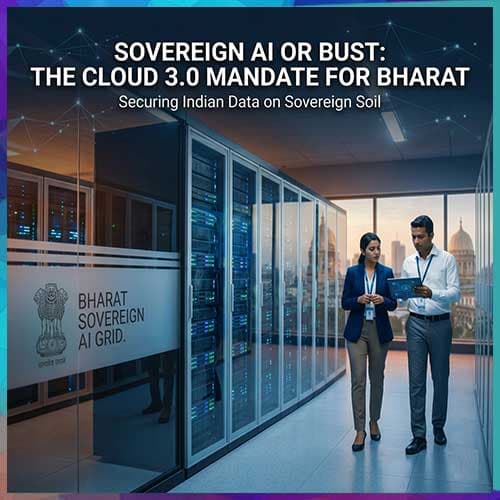
Author: Dhananjay Rokde, Principal Advisor & vCISO
The global enterprise architecture landscape is undergoing a violent paradigm shift. The permissive era of Cloud 2.0—characterized by the frictionless, cross-border pooling of enterprise data into centralized public clouds—has ended. Driven by the aggressive enforcement of the Digital Personal Data Protection Act (DPDPA) and the proliferation of Agentic AI, organizations face an existential regulatory threat: The Sovereign AI Mandate.
Our analysis across 42 jurisdictions reveals a critical vulnerability in the Indian enterprise ecosystem. Organizations are unknowingly exposing highly sensitive customer data (PII, financial, and behavioral telemetry) to foreign jurisdictions through third-party Large Language Model (LLM) APIs and Retrieval-Augmented Generation (RAG) pipelines.
The unvarnished reality: If your organization’s Indian customer data is being mathematically "refined," embedded, or processed in GPU clusters located in Virginia, Dublin, or Singapore, you are operating in direct violation of emerging sovereign data frameworks. You are exactly one regulatory audit away from an operational shutdown.
This whitepaper deconstructs the transition to Cloud 3.0, exposes the technical mechanics of AI-driven compliance failures, and outlines the boardroom mandate for implementing Zero-Infrastructure Data Security Posture Management (DSPM).
The Architectural Collapse of Cloud 2.0
For years, the "Big 4" advisory firms championed a monolithic approach to digital transformation: migrate everything to the public cloud, achieve economies of scale, and rely on generalized Service Level Agreements (SLAs) for security.
This model is fundamentally broken in the age of Generative AI.
In Cloud 2.0, data at rest was encrypted, and data in transit was secured via TLS. However, data in use—specifically data being processed by AI models—creates an unprecedented compliance blind spot. When an enterprise leverages a global AI provider to power its customer service chatbots, financial forecasting, or code generation, it is engaging in unauthorized data export.
The "Virginia GPU" Scenario
Consider a standard modern workflow: An Indian fintech company uses an AI agent to summarize customer loan applications.
â— The Action: The employee uploads the document to the enterprise AI portal.
â— The Invisible Transfer: The text is chunked, vectorized, and sent via API to an offshore LLM (e.g., hosted in US-East/Virginia).
â— The Refinement: The offshore GPU loads the data into its VRAM, processes the context window, and returns a generated output.
â— The Violation: The Indian citizen’s financial data has been exported, processed on foreign soil, and potentially retained in model telemetry logs or shadow caches, violating data localization and explicit consent mandates under the DPDPA.
The Weaponization of the DPDPA in 2026
The Digital Personal Data Protection Act is no longer a theoretical framework; it is a weaponized regulatory instrument. Regulators have moved past checking for basic encryption standards. They are now auditing the computational supply chain.
(A) The Fallacy of the "Data Processor" Defense
Enterprises often mistakenly believe that simply signing a Data Processing Agreement (DPA) with a global cloud provider indemnifies them from sovereign data breaches. It does not. Under the DPDPA, the Data Fiduciary (the enterprise) holds absolute liability. If a third-party AI model hallucinates, leaks, or improperly refines local data on foreign servers, the Fiduciary faces punitive action.
(B) Non-Human Identity (NHI) Sprawl
The defining security crisis of 2026 is NHI Debt. Enterprises now deploy autonomous AI agents that act as "Confused Deputies"—entities with high-level API access, database read/write privileges, and the ability to autonomously initiate outbound connections. Without rigorous identity governance tailored to AI, these agents inadvertently exfiltrate data to unauthorized offshore endpoints at machine speed.

Cloud 3.0: The Blueprint for Sovereign AI
The antidote to this compliance chasm is Cloud 3.0—a decentralized, jurisdictionally aware, and sovereign-by-design infrastructure model.
Organizations must rapidly decouple their AI ambitions from globalized, stateless APIs and rebuild their capabilities on sovereign soil. This requires a three-tiered architectural pivot:
Tier 1: Localized Inference and Foundational Models
Enterprises must transition from consuming APIs hosted abroad to deploying open-weight foundational models within sovereign data centers (or localized public cloud regions strictly geofenced within India). The GPU executing the inference must sit under the same legal jurisdiction as the data subject.
Tier 2: Sovereign RAG and Vector Isolation
Retrieval-Augmented Generation must be executed in isolated environments. Vector databases containing customer embeddings must never sync, replicate, or back up to international availability zones.
Tier 3: Continuous Data Security Posture Management (DSPM)
Traditional Data Loss Prevention (DLP) tools are blind to AI workflows. They cannot read context windows or monitor Model Context Protocol (MCP) streams. A next-generation DSPM is required.
The Boardroom Mandate & Action Plan
To prevent an audit-induced shutdown, Boards of Directors and C-suite executives must immediately implement the following directives, bypassing the bloated, multi-year roadmaps typically sold by legacy consulting firms.
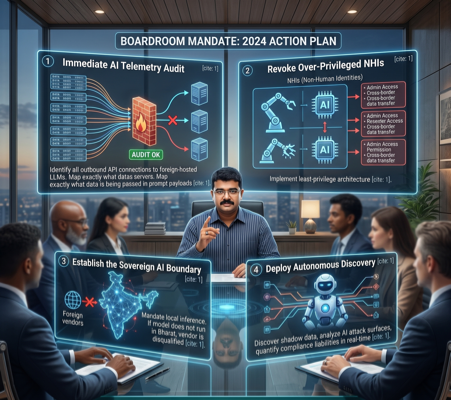
1. Immediate AI Telemetry Audit: Identify all outbound API connections to foreign-hosted LLMs. Map exactly what data is being passed in prompt payloads.
2. Revoke Over-Privileged NHIs: Conduct a sweeping audit of all service accounts, API keys, and machine identities associated with AI agents. Implement least-privilege architecture explicitly for Non-Human Identities.
3. Establish the Sovereign AI Boundary: Mandate that all future AI implementations, proof-of-concepts, and vendor procurements guarantee local inference. If the model does not run in Bharat, the vendor is disqualified.
4. Deploy Autonomous Discovery: Implement a platform capable of discovering shadow data, analysing AI attack surfaces, and quantifying compliance liabilities in real-time.
Conclusion: The iManEdge Citadel Paradigm
The future of the Indian startup ecosystem and enterprise landscape depends on indigenous IP and uncompromising data sovereignty. The choice is clear: build Sovereign AI, or face the inevitable consequences of the audit.