


Trust Before AI

Artificial Intelligence is rapidly moving beyond chatbots and copilots into autonomous AI agents capable of making decisions, triggering workflows, and interacting directly with enterprise systems. Organizations across banking, healthcare, telecom, manufacturing, and government are now exploring agentic AI to increase productivity, automate operations, and accelerate digital transformation.
However, autonomy without trust can create new risks faster than innovation. If AI systems rely on manipulated data, synthetic identities, or fragmented APIs, enterprises may unintentionally automate fraud, misinformation, and compliance failures. FaceOff Technologies believes that trusted data must become the foundation before AI agents are deployed at scale.
At the core of FaceOff Technologies is a simple philosophy: “AI agents cannot be trusted unless the data, identity, and behavioral signals behind them are trusted.” AI systems today depend on customer identities, enterprise records, voice interactions, video feeds, behavioral patterns, and API-driven workflows. If any of these layers are compromised, AI agents can make incorrect or dangerous decisions in real time.
One of the biggest emerging threats is synthetic identity fraud. Deepfake videos, AI-generated faces, cloned voices, and fake onboarding documents are becoming increasingly realistic. Fraudsters are already using these technologies to bypass verification systems and manipulate digital transactions. Without strong identity validation, AI agents may unknowingly approve fake users or trigger unauthorized financial activities.
FaceOff Technologies addresses this challenge through its Adaptive Cognito Engine (ACE), a multimodal AI trust platform designed to validate human authenticity, behavioral intent, and deepfake manipulation. ACE combines facial dynamics, voice analysis, gaze tracking, liveness detection, sentiment analysis, and behavioral biometrics to create what the company calls a “Human Trust Layer” for enterprise AI systems.
The platform works in multiple stages. First, it verifies whether a user is real, synthetic, manipulated, or part of a replay attack. Second, it analyzes behavioral indicators such as eye movement, voice stress, micro-expressions, and contextual anomalies. Third, it detects AI-generated media inconsistencies including GAN-generated faces, voice cloning, and audio-video mismatches. Finally, ACE generates a dynamic trust score based on identity confidence, device integrity, session context, and behavioral authenticity.
Recently, OpenAI announced initiatives to help users identify whether images are AI-generated or manipulated. While this is an important step toward AI transparency, FaceOff Technologies positions itself beyond image verification alone. Its enterprise-focused approach combines identity validation, multimodal forensics, behavioral intelligence, governance, consent management, and AI trust scoring into a unified platform designed for real-world enterprise security environments.
Another major enterprise concern is API fragmentation. Most organizations currently rely on multiple vendors for cybersecurity, consent management, privacy, fraud detection, deepfake analysis, and AI governance. This multi-API environment increases integration complexity, latency, operational costs, security gaps, and compliance exposure. FaceOff Technologies advocates a “Single Trust OEM” strategy where one integrated platform manages identity, privacy, governance, deepfake detection, and AI security together.
The company believes unified trust architecture is critical in the age of AI agents. A single OEM model reduces external integrations, improves auditability, creates centralized governance, lowers operational costs, and minimizes data leakage risks. More importantly, it delivers consistent trust scoring and stronger compliance management across enterprise ecosystems.
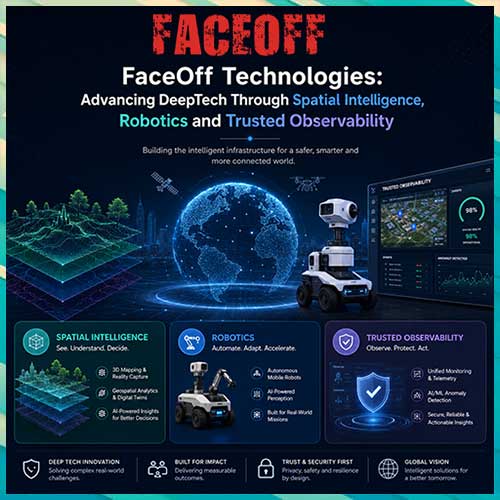
As AI agents begin operating banking systems, healthcare workflows, telecom onboarding, insurance processing, and government services, the future of enterprise AI will depend on trusted autonomy rather than uncontrolled automation. FaceOff Technologies is positioning itself as a next-generation trust infrastructure company focused on behavioral authenticity, AI forensics, privacy-first governance, and secure AI interactions.
The next phase of AI transformation will not belong only to the most intelligent systems. It will belong to the most trusted systems. In the era of autonomous AI agents, trusted data, behavioral intelligence, unified governance, and privacy-preserving security will become the true foundation of enterprise innovation.
|
Capability |
FaceOff Technologies |
OpenAI AI Image Verification Initiative |
|
Deepfake Detection |
Yes |
Primarily image authenticity focus |
|
Real-time Trust Scoring |
Yes |
Limited |
|
Behavioral Intelligence |
Yes |
No |
|
Voice + Face Correlation |
Yes |
Limited |
|
Human Intent Analysis |
Yes |
No |
|
Enterprise Identity Validation |
Yes |
No |
|
Video KYC Support |
Yes |
No |
|
Fraud Detection |
Yes |
Limited |
|
Multimodal AI Forensics |
Yes |
Partial |
|
Consent Governance |
Yes |
No |
|
Data Privacy Layer |
Yes |
Limited |
|
API Consolidation |
Yes |
No |
|
Unified OEM Platform |
Yes |
No |
|
Regulatory Compliance Readiness |
Yes |
Partial |
|
AI Agent Trust Infrastructure |
Yes |
Emerging |
|
Post-Quantum Security Vision |
Yes |
Not core focus |

See What’s Next in Tech With the Fast Forward Newsletter







Tweets From @varindiamag
Nothing to see here - yet
When they Tweet, their Tweets will show up here.