
The looming 18-day strike at Samsung Electronics has raised alarm within the South Korean government, rattled investors, and sparked concerns regarding disrupting global semiconductor supply chains. At the heart of the dispute is a growing debate over how the benefits of the AI boom should be shared among employees.
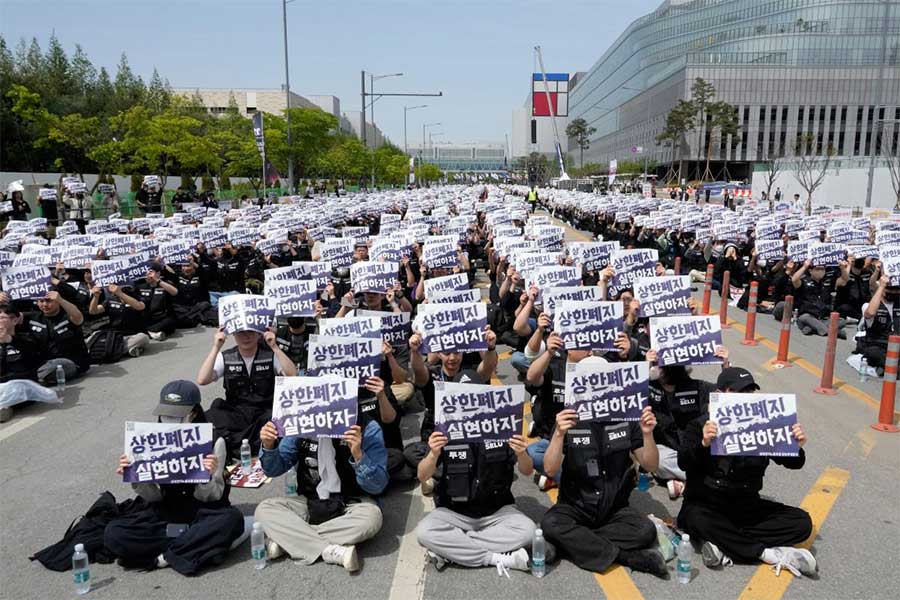
More than 45,000 workers are threatening to walk out from May 21. The action could disrupt production of memory chips, key components used in AI data centers, smartphones, and laptops, as the company and its union remain deadlocked over bonus payouts.
Samsung Electronics, which has enjoyed strong profits from a global memory chip shortage, has proposed generous bonuses for employees. But it wants to give 27,000 memory chip employees at least six times more than its other workers in its logic chip design and manufacturing businesses.
The union argues that employees working on logic chips and foundry operations — including chips supplied to companies such as Tesla and NVIDIA — should not be excluded, especially since many work in the same facilities as memory division staff. The logic chip and foundry businesses, however, have suffered heavy losses in recent years as Samsung struggled to compete effectively in the contract chip manufacturing market.
A news source has reviewed the internal wage negotiation transcripts and spoke to workers and union leaders, and sources familiar with the discussions. Employees described deepening dissatisfaction, internal competition, and a growing talent drain.
The dispute also exposes challenges linked to Samsung’s long-standing strategy of becoming the only semiconductor company capable of offering a comprehensive “one-stop” chip ecosystem spanning memory, logic chips, and foundry services. Unlike more specialized rivals such as Micron Technology or TSMC, Samsung operates multiple semiconductor businesses under one umbrella — a structure that some analysts say is now creating internal friction.
Samsung's Device Solutions Division includes three main businesses - memory, system LSI, and foundry - and the AI boom has made these divisions wildly unequal in profitability. Samsung is the world's top memory chipmaker by sales but also makes televisions and smartphones.
Namuh Rhee, chairman of a Korean corporate governance group, said Samsung’s structure was partly responsible for the current crisis. He argued that combining different businesses under one organization has created conflicts of interest, reduced flexibility, and contributed to valuation discounts.
Employee frustration reportedly escalated last year after rival SK Hynix removed its bonus cap, resulting in payouts more than three times larger than Samsung’s. The disparity reportedly encouraged several Samsung employees to leave.
In March, Samsung proposed bonuses equivalent to 607% of annual salaries for memory chip employees — potentially higher than those at SK Hynix. By contrast, employees in logic chip businesses working on AI-related technologies such as base die components would receive bonuses ranging between 50% and 100% of annual salary.
Union officials argued that the big gap in bonuses would push logic chip employees to leave for the memory unit or for other companies, crippling it after Samsung Chairman Jay Y. Lee said he wants to be the "clear No. 1" in the logic chip market by 2030.
"If the memory division gets 500 million won while the foundry division only gets 80 million won, what motivation would those employees have to keep â working?" said union leader Choi Seung-ho during negotiations, according to the transcripts.
The union's demands include requests for Samsung to abolish a bonus cap of 50% of annual salaries and allocate 15% of annual operating profit to a bonus pool distributed to workers.
Samsung management, however, insists that performance-based compensation should reflect business results. "They, the logic chip business, posted losses in the trillions of won and honestly, if it had not been for our company, they probably would have gone out of business or closed down," said Samsung executive and negotiator Kim Hyung-ro, according â to the transcripts. "So how can you justify giving performance bonuses?"
"The company still has faith in this business and continues to invest consistently in facilities - and in reality, those investments are being funded with money earned from the memory business."
In a statement, Samsung said "the logic chip business is a strategically significant business which we have continuously invested in, guided by our long-term vision."
"Samsung Electronics will offer its employees the best compensation in the industry" with the latest proposal, it said.
Samsung also said that should the strike go ahead, a failure to deliver to customers would result in "a complete loss of trust."
The potential strike has triggered concerns beyond Samsung itself. South Korean government officials, investors, and business groups fear the disruption could hurt the country’s broader economy and weaken confidence in Korea’s manufacturing sector.
In an internal memo earlier this month, Samsung’s board chairman reportedly warned that a strike could lead to capital outflows, reduced tax revenues, and pressure on the South Korean won.
In late April, South Korean President Lee Jae Myung said some unions were making excessive demands, in remarks that were widely perceived as aimed at Samsung's unions.
The American Chamber of Commerce in Korea said the labour uncertainty could affect confidence in Korea's reputation as a dependable partner in global manufacturing and supply chains.
Analysts said other companies were watching the dispute as â a potential barometer for labor-management relations.
"If Samsung sets a precedent in which union demands are pushed through by means of a strike, companies could find themselves in a very unfavorable bargaining position in the future," Korea University law professor Park Ji-soon said.